Photo Credit: Facebook
 0
 0
The NFL has produced legendary quarterbacks, explosive running backs, and unstoppable offenses throughout its history. However, defense has often separated championship teams from everyone else. Some defenses intimidated opponents before the opening kickoff. Others dominated through relentless pressure, devastating tackles, and turnovers that changed games. The greatest defensive units also created identities that football fans still recognize decades later. The Chicago Bears had the Monsters of the Midway. Pittsburgh introduced the Steel Curtain. Baltimore built a defensive powerhouse that carried the Ravens to a championship. Meanwhile, Tampa Bay, Seattle, Denver, and New England developed their own championship-winning defensive identities. But which defenses deserve recognition among the greatest in NFL history? Comparing different eras creates challenges because football has changed dramatically. Modern offenses enjoy rules that favor passing, while earlier generations featured more physical defensive play. Nevertheless, championships, statistical dominance, individual talent, and historical impact help separate the greatest units.
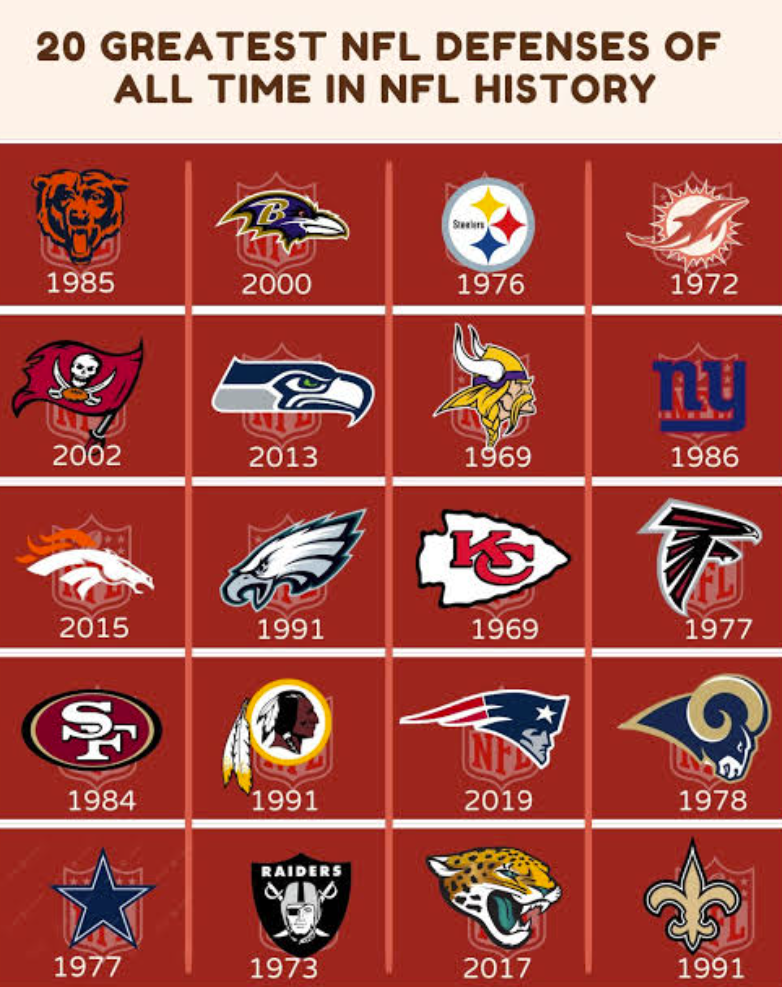
1985 Chicago Bears: Monsters of the Midway
The 1985 Chicago Bears remain the standard for defensive dominance in many football discussions. Head coach Mike Ditka assembled an outstanding roster. However, defensive coordinator Buddy Ryan created the system that terrified opposing offenses. Ryan’s famous 46 defense overwhelmed offensive lines with aggressive pressure and unpredictable formations. Mike Singletary anchored the defense at linebacker. Richard Dent, Dan Hampton, Steve McMichael, and Wilber Marshall provided additional star power. Chicago finished the regular season 15-1 and allowed just 198 points. The Bears also recorded 64 sacks during the regular season. Their playoff performances demonstrated even greater dominance. Chicago shut out the New York Giants 21-0 before destroying the Los Angeles Rams 24-0. Finally, the Bears defeated the New England Patriots 46-10 in Super Bowl XX. The defense helped force six New England turnovers during that championship victory. Few teams have combined personality, physical intimidation, and statistical dominance like the 1985 Bears.
1976 Pittsburgh Steelers: The Steel Curtain
The Pittsburgh Steelers established one of football’s greatest dynasties during the 1970s. Their legendary Steel Curtain defense featured Joe Greene, L.C. Greenwood, Dwight White, and Ernie Holmes. Jack Lambert, Jack Ham, Mel Blount, and Donnie Shell strengthened an already frightening defensive unit. Although Pittsburgh won four Super Bowls during the decade, its 1976 defense deserves special recognition. The Steelers allowed just 138 points across 14 regular-season games. Even more impressively, Pittsburgh recorded five shutouts during the season. The Steelers surrendered only 28 points over their final nine regular-season contests. Pittsburgh finished 10-4 after overcoming a disastrous 1-4 start. Unfortunately, injuries weakened the offense before the AFC Championship Game. Oakland defeated Pittsburgh 24-7, ending the Steelers’ championship hopes. Despite that defeat, the 1976 defense remains among the greatest statistical units in NFL history.
2000 Baltimore Ravens: Defensive Perfection
The 2000 Baltimore Ravens built their championship season around one of football’s most dominant defenses. Ray Lewis led a unit featuring Rod Woodson, Tony Siragusa, Sam Adams, Peter Boulware, and Jamie Sharper. Baltimore allowed just 165 points during the regular season, averaging 10.3 per game. The Ravens also surrendered only 60.6 rushing yards per contest. Additionally, Baltimore forced 49 turnovers, consistently providing opportunities for an inconsistent offense. The Ravens finished 12-4 despite experiencing serious offensive struggles throughout the season. However, their defense carried them through the playoffs. Baltimore eventually defeated the New York Giants 34-7 in Super Bowl XXXV. The Giants managed no offensive touchdowns during the championship game. Ray Lewis earned Super Bowl MVP honors for his outstanding defensive leadership. Baltimore’s historic scoring record gives this defense a legitimate argument for the greatest ever.
2002 Tampa Bay Buccaneers: Tampa 2 Takes Over
The 2002 Tampa Bay Buccaneers deserve consideration alongside Chicago, Pittsburgh, and Baltimore. Head coach Jon Gruden inherited an outstanding defense that Tony Dungy helped develop. Defensive coordinator Monte Kiffin perfected the Tampa 2 system, emphasizing disciplined coverage and aggressive pursuit. Warren Sapp controlled the defensive line, while Derrick Brooks dominated at linebacker. John Lynch delivered punishing hits, and Ronde Barber became one of football’s most dangerous defensive backs. Simeon Rice also provided relentless pressure against opposing quarterbacks.
Tampa Bay allowed only 196 points during the regular season, averaging 12.3 per game. The Buccaneers finished 12-4 and captured the NFC South championship. Their defining postseason moment came against Philadelphia in the NFC Championship Game. Barber intercepted Donovan McNabb and returned the football 92 yards for a touchdown. Tampa Bay defeated Philadelphia 27-10 before facing Oakland in Super Bowl XXXVII. The Buccaneers intercepted Raiders quarterback Rich Gannon five times and returned three interceptions for touchdowns. Tampa Bay won 48-21, securing the franchise’s first Super Bowl championship. Few defenses have produced a more convincing championship performance.
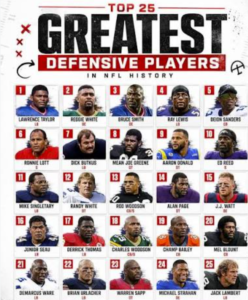
2013 Seattle Seahawks: Legion of Boom
The 2013 Seattle Seahawks featured one of the greatest defensive backfields in football history. Richard Sherman, Earl Thomas, Kam Chancellor, and Byron Maxwell formed the foundation of Seattle’s Legion of Boom. Meanwhile, Bobby Wagner and K.J. Wright provided outstanding linebacker play. Michael Bennett and Cliff Avril helped generate pressure without constant blitzing. Seattle allowed just 231 points during the regular season, leading the NFL in scoring defense. The Seahawks also led the league in total defense and passing defense. Their physical secondary disrupted receivers while their disciplined coverage frustrated opposing quarterbacks.
However, Super Bowl XLVIII provided their greatest achievement. Seattle faced Peyton Manning and the Denver Broncos, who had produced a record-setting offensive season. Instead of surrendering to Denver’s passing attack, Seattle dominated from the opening snap. Malcolm Smith returned an interception 69 yards for a touchdown. The Seahawks eventually destroyed Denver 43-8. Seattle demonstrated that physical defense could still overwhelm elite passing offenses.
2015 Denver Broncos: No Fly Zone
The 2015 Denver Broncos relied heavily on their defense during Peyton Manning’s final season. Von Miller and DeMarcus Ware formed a devastating pass-rushing combination. Meanwhile, Aqib Talib, Chris Harris Jr., and Bradley Roby strengthened Denver’s outstanding secondary. T.J. Ward provided additional toughness at safety. Defensive coordinator Wade Phillips built a unit capable of overwhelming quarterbacks with pressure and tight coverage. Denver allowed just 283.1 yards per game, leading the NFL in total defense. The Broncos finished 12-4 and reached Super Bowl 50 against the Carolina Panthers. Carolina entered the championship with the NFL’s highest-scoring offense. However, Denver’s defense completely disrupted quarterback Cam Newton. Miller forced two crucial fumbles, including one that produced Denver’s first touchdown. The Broncos defeated Carolina 24-10, and Miller earned Super Bowl MVP honors. Denver’s championship proved that an exceptional defense could overcome an inconsistent offense.
1986 New York Giants: Lawrence Taylor’s Dominance
The 1986 New York Giants featured arguably the greatest defensive player in league history. Lawrence Taylor revolutionized the outside linebacker position with his speed, strength, and relentless pass rushing. Taylor recorded 20.5 sacks and captured NFL MVP honors. Harry Carson, Carl Banks, and Leonard Marshall strengthened a defense that intimidated opposing offenses. Head coach Bill Parcells and defensive coordinator Bill Belichick created a disciplined, aggressive system. New York finished 14-2 before dominating the postseason. The Giants defeated San Francisco 49-3 in the divisional round. Next, New York shut out Washington 17-0 in the NFC Championship Game. Finally, the Giants defeated Denver 39-20 in Super Bowl XXI. Their postseason performances demonstrated how preparation and elite talent could overwhelm championship-caliber opponents.
1977 Atlanta Falcons: The Grits Blitz
The 1977 Atlanta Falcons rarely receive the recognition they deserve. However, their defense established a remarkable scoring record during the 14-game season. Atlanta allowed just 129 points, averaging 9.2 per contest. Defensive coordinator Jerry Glanville developed the aggressive Grits Blitz system. Claude Humphrey, Fulton Kuykendall, and Rolland Lawrence helped make Atlanta extremely difficult to score against. Unfortunately, the Falcons lacked the offensive production necessary to become championship contenders. Atlanta finished just 7-7 and missed the playoffs. Nevertheless, their scoring defense remains historically significant. The Falcons prove that greatness should not depend entirely on Super Bowl victories.
1969 Minnesota Vikings: The Purple People Eaters
The Minnesota Vikings built their identity around the legendary Purple People Eaters. Alan Page, Carl Eller, Jim Marshall, and Gary Larsen formed one of football’s most intimidating defensive lines. Minnesota finished 12-2 during the 1969 regular season. The Vikings allowed just 133 points and reached Super Bowl IV. However, Kansas City defeated Minnesota 23-7. Despite that loss, the Vikings continued producing outstanding defenses throughout the early 1970s. Their 1970 and 1971 teams also ranked among the NFL’s stingiest scoring defenses. Page became the first defensive player to win NFL MVP honors in 1971. Minnesota’s sustained excellence makes the Purple People Eaters essential to any historical discussion.
1972 Miami Dolphins: Perfect Season Defense
The 1972 Miami Dolphins remain the only team to complete an undefeated, untied season through the Super Bowl. Although Miami’s rushing attack received considerable attention, its defense played an equally important role. Nick Buoniconti, Jake Scott, Manny Fernandez, and Bill Stanfill anchored the No-Name Defense. Miami allowed only 171 points during its 14-game regular season. The Dolphins finished 14-0 before winning three postseason games. Their defense delivered another outstanding performance against Washington in Super Bowl VII. Miami won 14-7 and completed its historic 17-0 season. Scott earned Super Bowl MVP honors after recording two interceptions. While other defenses produced better statistics, Miami achieved something no modern NFL team has matched.
2008 Pittsburgh Steelers: A Modern Steel Curtain
The 2008 Steelers continued Pittsburgh’s tradition of championship defense. James Harrison, Troy Polamalu, LaMarr Woodley, James Farrior, and Casey Hampton anchored an exceptional unit. Defensive coordinator Dick LeBeau used creative blitz packages to confuse opposing quarterbacks. Pittsburgh allowed just 223 points during the regular season, averaging 13.9 per game. The Steelers also led the NFL in total defense. Their defining moment came during Super Bowl XLIII against the Arizona Cardinals. Harrison intercepted Kurt Warner near Pittsburgh’s goal line before halftime. He returned the interception 100 yards for a touchdown. The Steelers eventually defeated Arizona 27-23. Although Santonio Holmes earned Super Bowl MVP honors, Pittsburgh’s defense played a crucial role throughout the championship season.
Other Legendary NFL Defenses Deserving Recognition
Several additional teams belong in any serious conversation about defensive greatness. The 1962 Green Bay Packers featured Willie Davis, Ray Nitschke, Herb Adderley, and Willie Wood. Vince Lombardi’s team finished 13-1 and captured the NFL championship. The 1969 Kansas City Chiefs combined Willie Lanier, Bobby Bell, Buck Buchanan, and Emmitt Thomas. Their defense helped defeat Minnesota in Super Bowl IV. The 1975 Los Angeles Rams allowed just 135 points across 14 regular-season games. Jack Youngblood and Merlin Olsen anchored their formidable defensive line.
The 1977 Denver Broncos introduced the Orange Crush defense to a national audience. Randy Gradishar and Tom Jackson helped Denver reach Super Bowl XII. The 1986 Chicago Bears allowed just 187 regular-season points, fewer than their famous 1985 predecessors. However, Washington ended their season in the divisional playoffs. The 1991 Philadelphia Eagles featured Reggie White, Jerome Brown, Clyde Simmons, and Seth Joyner. Their defense led the league in both rushing and passing yards allowed.
The 1996 Green Bay Packers allowed 210 points and captured Super Bowl XXXI. Reggie White and LeRoy Butler helped establish an outstanding championship defense. The 2000 Tennessee Titans also deserve recognition. Tennessee allowed just 191 regular season points before Baltimore eliminated the Titans in the playoffs. The 2006 Baltimore Ravens allowed only 201 points during the regular season. Ray Lewis, Ed Reed, Terrell Suggs, and Adalius Thomas led the unit. The 2005 Chicago Bears allowed just 202 points. Their 2006 successors reached Super Bowl XLI behind Brian Urlacher, Lance Briggs, and a turnover-producing defense.
The 2019 New England Patriots featured Stephon Gilmore, Devin McCourty, and Dont’a Hightower. New England allowed just 225 points while producing 36 takeaways. More recently, the 2023 Cleveland Browns displayed outstanding defensive talent behind Myles Garrett and Denzel Ward. Cleveland led the league in total defense. These teams demonstrate that exceptional defense extends far beyond the most celebrated Super Bowl champions.
Which NFL Defense Deserves the Greatest-Ever Crown?
Selecting one defense requires balancing statistics, championships, competition, and historical influence. Chicago’s 1985 defense combined all four elements at an extraordinary level. Baltimore’s 2000 unit established a modern scoring standard while carrying an inconsistent offense to a championship. Pittsburgh’s 1976 defense dominated opponents statistically but never reached the Super Bowl. Meanwhile, Tampa Bay’s 2002 defense delivered one of the greatest championship performances in league history. Seattle’s Legion of Boom also deserves consideration because of its dominance against modern passing offenses. Denver’s 2015 defense demonstrated similar excellence against three dangerous playoff opponents.
However, the 1985 Bears remain my choice as the greatest overall defense. Their combination of aggression, talent, postseason dominance, and cultural impact separates them from the competition. Still, Baltimore and Pittsburgh have legitimate arguments, especially when comparing regular-season statistics. Ultimately, the NFL’s greatest defenses share one defining characteristic. They controlled games even when their offenses struggled. Great quarterbacks can win championships, and explosive offenses can break records. However, legendary defenses create something even more memorable. They make opposing teams question whether they can score at all. And that is why defense will always remain one of football’s greatest traditions.
NGSC Sports accepts premium guest commentary, contextual link insertions, and native brand features. Review our Advertising & Guest Post Guidelines (https://ngscsports.com) to secure your placement today.



Author Profile

-
Bradley Walker (VP) and Head of our Florida operations for NGSC Sports, bringing extensive experience across collegiate, professional, and amateur athletics. His coverage spans USF Athletics, including football, baseball, lacrosse, and softball, as well as University of Tampa baseball.
Bradley also provides coverage of minor league baseball with the Clearwater Threshers and Major League Baseball with the Tampa Bay Rays. On the national stage, he covers college football bowl games and conference championship matchups, along with premier golf events across the PGA Tour, LIV Golf, and LPGA Tour.
In addition to his reporting work, Bradley is the play-by-play announcer for Pinellas Park High School Patriots football, lending his voice and insight to Friday night lights.
He is also an active podcast host and contributor, serving as a host on The Walker Report, where he delivers in-depth sports analysis, interviews, and coverage across multiple levels of competition.
Latest entries
 FootballOctober 21, 2026NFL’s Greatest Defenses: The Most Dominant Units in Football History
 FootballOctober 21, 2026Buccaneers vs. Panthers: NFC South Showdown
 FootballOctober 21, 2026Patriots vs. Bears: Thursday Night Football Showdown
 AAC FootballOctober 21, 2026American Football Week 8: Road Tests Loom
About the Author