
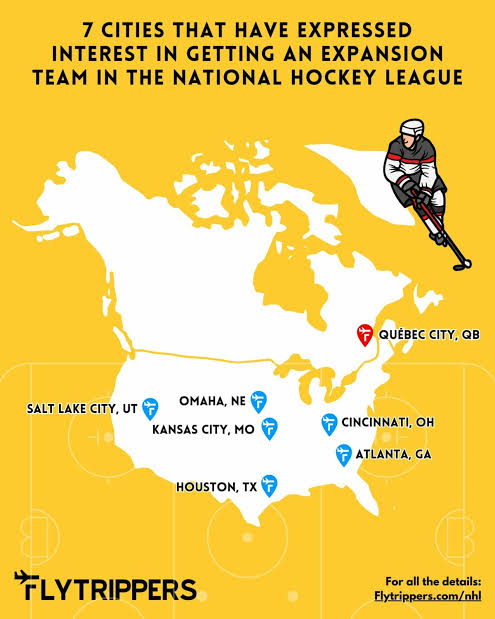
Photo Credit: FlyTrippers
 0
0
 0
0
NHL expansion continues to generate excitement across North America. League officials recently opened discussions about Austin, Texas, as a potential expansion market. That decision confirmed what many hockey fans already expected. The NHL appears ready to grow again within the next several years. However, the league will likely add two teams instead of one. As a result, several cities continue building strong cases for future franchises.
Many markets already feature professional sports, established arenas, and passionate fan bases. Others hope wealthy ownership groups can strengthen their bids. Although every city offers unique advantages, several obstacles remain. Expansion fees now reach billions of dollars, making financial backing just as important as market size. Therefore, only cities with committed investors and long-term plans will likely receive serious consideration.
Austin currently leads many expansion conversations because it checks several important boxes. The Texas capital continues growing rapidly and already supports Austin FC in Major League Soccer. Meanwhile, the city has hosted the Texas Stars, the American Hockey League affiliate of the Dallas Stars, since 2009. That history gives local fans some familiarity with professional hockey.
Austin also stands out because it lacks teams from the NFL, MLB, NBA, and NHL. Consequently, an NHL franchise could immediately become one of the city’s premier professional sports attractions. The University of Texas already creates tremendous sports enthusiasm, especially during football season. Even so, Austin’s expanding technology industry and growing population provide another attractive audience for professional hockey.
The NHL also values markets with strong ownership groups. Billionaire businessman Dan Friedkin reportedly continues exploring expansion opportunities in Texas. His financial resources could remove one of the biggest hurdles facing any expansion effort. Furthermore,
Austin resembles previous successful expansion markets like Las Vegas and Seattle. Those cities featured growing populations, committed ownership, and eager sports fans. Austin appears capable of following that same blueprint.
Houston remains another outstanding candidate for NHL expansion. The city boasts one of America’s largest populations and media markets. Additionally, Houston already supports franchises in the NFL, MLB, NBA, MLS, and the NWSL. That sports culture demonstrates the city’s ability to embrace another major professional team.
Houston also owns a rich hockey history. The legendary Howe family starred for the Houston Aeros during the World Hockey Association era. Later, the Aeros returned through the International Hockey League and American Hockey League. Those teams built loyal followings that many longtime hockey fans still remember today.
Dan Friedkin reportedly continues examining Houston alongside Austin. Therefore, many observers believe Houston remains extremely close to securing an NHL franchise. The city’s size, financial backing, and sports infrastructure create a compelling expansion package. Still, Austin currently receives slightly more attention because professional sports competition remains less crowded there.
Atlanta ranks among the strongest non-Texas candidates. The city previously lost two NHL franchises despite representing one of America’s largest television markets. Most recently, the Atlanta Thrashers relocated to Winnipeg after the 2011 season. Poor ownership played a major role in that move rather than weak market potential.
Today, Atlanta has renewed hope through multiple investment groups pursuing expansion opportunities. Each group has proposed arena developments and ownership plans. However, competing proposals also create uncertainty. Until local investors unite behind one clear vision, Atlanta could struggle against more organized expansion bids. Nevertheless, the market remains highly attractive because of its population and corporate presence.
Phoenix also deserves serious attention despite the Arizona Coyotes’ recent departure. The NHL spent decades supporting hockey in Arizona because league officials believed strongly in the region’s potential. Unfortunately, ownership problems repeatedly undermined that effort. Those issues eventually forced the franchise to relocate.
Even so, Phoenix continues offering tremendous value through its massive population and television market. The biggest challenge involves securing stable ownership alongside a modern arena. Whether that facility rises in Phoenix, Scottsdale, or Tempe, league officials would likely welcome another opportunity in Arizona. However, the city must organize quickly while other expansion candidates continue advancing.
Québec City remains the sentimental favorite among many longtime hockey fans. The city still treasures memories of the Nordiques, who relocated to Denver in 1995. Even today, local supporters eagerly await another chance to cheer for NHL hockey. The impressive Videotron Centre already stands ready to host a franchise immediately.
Unfortunately, economic realities continue hurting Québec City’s chances. The Canadian dollar remains weaker than the American dollar. Additionally, the city’s population has not experienced significant growth since the Nordiques departed. Expansion fees also continue climbing dramatically. Those financial challenges make attracting investors increasingly difficult compared with larger American markets.
Indianapolis also enters expansion discussions because of its respected sports culture. Hockey history connects deeply with the city because Wayne Gretzky and Mark Messier began their professional careers there with the Indianapolis Racers. Although that chapter ended decades ago, hockey never disappeared completely from the city.
The Indianapolis Fuel have represented the ECHL since 2014. Meanwhile, Indianapolis successfully supports the NFL’s Colts and the NBA’s Pacers. The city also regularly hosts the NCAA Men’s Final Four. Those accomplishments demonstrate strong experience with major sporting events. Still, expansion costs remain a major obstacle for any ownership group hoping to enter the NHL.
New Orleans rounds out the expansion conversation despite facing significant challenges. The city enjoys passionate support for the Saints and Pelicans. However, professional hockey has never established lasting success there. The ECHL’s New Orleans Brass operated only from 1997 through 2002 before folding.
The Smoothie King Center could accommodate NHL games because the Pelicans serve as its primary tenant. Even so, finding investors willing to spend billions on expansion remains difficult. Therefore, New Orleans appears less likely than several competing cities despite possessing a suitable arena.
The NHL clearly sees expansion as part of its future. Austin and Houston currently occupy the strongest positions because they combine growing populations, financial strength, and expanding sports markets. Atlanta and Phoenix remain serious contenders if ownership questions receive answers. Meanwhile, Québec City, Indianapolis, and New Orleans continue hoping circumstances eventually improve.
Although league officials have not announced formal expansion plans, momentum continues building. Whenever the NHL officially expands again, Texas appears positioned to welcome another franchise. The remaining cities must continue strengthening ownership groups, developing arenas, and proving they can support hockey for decades to come.



Author Profile

-
Bradley Walker (VP) and Head of our Florida operations for NGSC Sports, bringing extensive experience across collegiate, professional, and amateur athletics. His coverage spans USF Athletics, including football, baseball, lacrosse, and softball, as well as University of Tampa baseball.
Bradley also provides coverage of minor league baseball with the Clearwater Threshers and Major League Baseball with the Tampa Bay Rays. On the national stage, he covers college football bowl games and conference championship matchups, along with premier golf events across the PGA Tour, LIV Golf, and LPGA Tour.
In addition to his reporting work, Bradley is the play-by-play announcer for Pinellas Park High School Patriots football, lending his voice and insight to Friday night lights.
He is also an active podcast host and contributor, serving as a host on The Walker Report, where he delivers in-depth sports analysis, interviews, and coverage across multiple levels of competition.
Latest entries
 AAC FootballSeptember 20, 2026USF Rolls Past Delaware State 59-17
 FootballSeptember 20, 2026Florida Stuns Auburn, 34-24, in SEC Opener
 GolfSeptember 20, 2026PGA Tour’s 2028 Two-Tier System Changes Golf Forever
 FootballSeptember 20, 2026Pinellas Football Week 5: Big Wins and Big Statements
About the Author