 0
0
 0
0
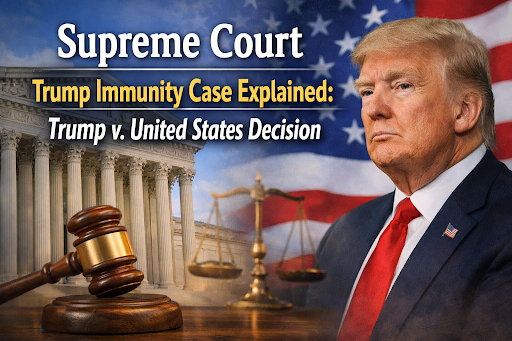
The debate around presidential power in the United States reached a historic moment when the Supreme Court considered the issue of presidential immunity in the case commonly known as Trump v. United States. The decision raised important questions about the limits of executive authority and whether a former president can face criminal prosecution for actions taken while in office.
The Supreme Court Trump immunity ruling quickly became one of the most discussed legal developments in modern American politics. Supporters argued that presidents must be protected from politically motivated prosecutions, while critics warned that excessive immunity could place presidents above the law.
Understanding the legal background, the arguments presented in court, and the potential impact of the ruling is essential for anyone interested in constitutional law, American politics, and the balance of power within the U.S. government.
Understanding Presidential Immunity
Presidential immunity refers to legal protection that shields a sitting or former president from certain types of lawsuits or criminal prosecution related to official actions performed while in office.
The concept is based on the idea that the president must be able to perform duties without fear of constant legal challenges. Without such protection, presidents could face numerous lawsuits that might interfere with their ability to govern effectively.
Historically, U.S. courts have recognized limited forms of presidential immunity, particularly for civil cases related to official duties. However, the question of criminal immunity for former presidents had never been directly decided by the Supreme Court until the Trump immunity case.
This legal uncertainty made the case extremely significant for constitutional law.
Background of Trump v. United States
The case of Trump v. United States emerged from investigations into actions taken after the 2020 presidential election. Prosecutors argued that certain actions by Donald Trump could potentially violate federal law.
Trump’s legal team responded by arguing that presidents should have immunity from criminal prosecution for actions connected to official responsibilities. They claimed that allowing prosecution could set a dangerous precedent where future presidents face politically motivated charges after leaving office.
This argument brought the issue of presidential immunity to the Supreme Court, forcing the justices to examine the boundaries between executive authority and legal accountability.
Because no former president had ever faced similar criminal charges before, the case represented an unprecedented constitutional challenge.
Key Legal Questions in the Case
Several major legal questions were raised during the Supreme Court proceedings.
First, the Court needed to determine whether former presidents could be prosecuted for actions taken during their time in office.
Second, the justices had to decide how to distinguish between official presidential acts and private actions. This distinction is important because immunity typically applies only to official duties.
Third, the Court examined whether allowing criminal prosecution could interfere with the functioning of the executive branch.
These questions made the case extremely complex and forced the Court to balance two fundamental principles: protecting presidential independence and maintaining accountability under the law.
The Supreme Court’s Decision
The Supreme Court ultimately ruled that former presidents do have some level of immunity for official acts performed while serving as president. However, the Court clarified that this protection is not absolute.
According to the ruling, actions taken as part of official presidential duties may be protected from criminal prosecution. At the same time, actions that are considered private or unofficial do not receive the same protection.
This distinction means that courts must examine each situation carefully to determine whether a president’s actions fall within official responsibilities.
The decision, therefore, created a legal framework that future courts can use when evaluating cases involving presidential conduct.
Official Acts vs. Private Actions
One of the most important aspects of the Trump immunity ruling is the difference between official acts and private actions.
Official acts generally involve responsibilities that are clearly part of the president’s constitutional duties. These may include communications with government officials, decision-making related to national policy, or actions connected to executive authority.
Private actions, on the other hand, involve conduct that is unrelated to official presidential duties. Such actions may include personal business activities, campaign matters, or other non-governmental conduct.
The Supreme Court emphasized that immunity should only apply to official acts. This distinction is intended to protect legitimate presidential decision-making while still allowing accountability for conduct outside official responsibilities.
Why the Ruling Matters
The Supreme Court’s Trump immunity decision has major implications for the future of American politics and constitutional law.
First, it establishes that former presidents are not completely immune from criminal prosecution. This principle reinforces the idea that no one is above the law.
Second, the ruling also protects the independence of the presidency by ensuring that presidents are not constantly threatened with prosecution for performing their duties.
Finally, the decision guides courts handling similar cases in the future. Judges must now evaluate whether presidential actions are official or private before determining whether immunity applies.
This legal framework will likely influence constitutional debates for many years.
Reactions to the Decision
The ruling generated strong reactions from legal experts, politicians, and the public.
Supporters of the decision argued that it protects the presidency from political retaliation. They believe that without some form of immunity, future presidents might hesitate to make difficult decisions out of fear of prosecution.
Critics, however, expressed concern that the ruling could expand presidential power too far. Some legal scholars warned that broad immunity could weaken accountability and allow abuse of executive authority.
Despite these debates, many experts agree that the Court attempted to strike a balance between protecting presidential independence and maintaining the rule of law.
Impact on Future Presidents
The Trump immunity case will likely shape how future presidents approach decision-making while in office.
Presidents may feel more secure knowing that official actions are protected to some degree from later prosecution. At the same time, the ruling sends a clear message that private conduct does not receive the same legal protection.
Future administrations will likely rely on legal advisers to ensure that presidential decisions remain within the boundaries of official authority.
Additionally, courts may face new legal challenges as lawyers attempt to interpret what qualifies as an official act.
Broader Constitutional Implications
Beyond the specific case, the Supreme Court’s decision contributes to the ongoing debate about executive power in the United States. The Constitution provides significant authority to the president, but it also establishes a system of checks and balances among the branches of government. The Trump immunity ruling highlights the complexity of maintaining this balance. Protecting the presidency is important, but so is ensuring that government officials remain accountable under the law. As discussed by legal analysts and platforms like Words Craze, the decision continues to spark important conversations about constitutional limits and executive authority. As legal scholars continue to analyze the ruling, it will likely influence future discussions about the limits of presidential authority.
Conclusion
The Supreme Court Trump immunity ruling in Trump v. United States represents a landmark moment in American constitutional law. For the first time, the Court directly addressed the question of whether a former president can face criminal prosecution for actions taken while in office.
The decision confirms that presidents have limited immunity for official acts but not for private conduct. This approach attempts to protect the functioning of the executive branch while maintaining the principle that no one is above the law.
As courts interpret the ruling in future cases, its impact on presidential power, legal accountability, and constitutional interpretation will continue to shape American politics for years to come.



Author Profile

Latest entries
 healthApril 3, 2026Rocks Discount Vitamins – Save on Quality Supplements
 MLBApril 2, 2026Breakout MLB Teams Bettors Should Be Watching in the 2026 Season
 MLBApril 1, 2026MLB Weekly Digest: The Top Storylines from the Diamond
 The HubApril 1, 2026Lymphatic Organic Las Vegas | Detox Massage Therapy Center
About the Author