Photo Credit: Chat GPT
 0
 0
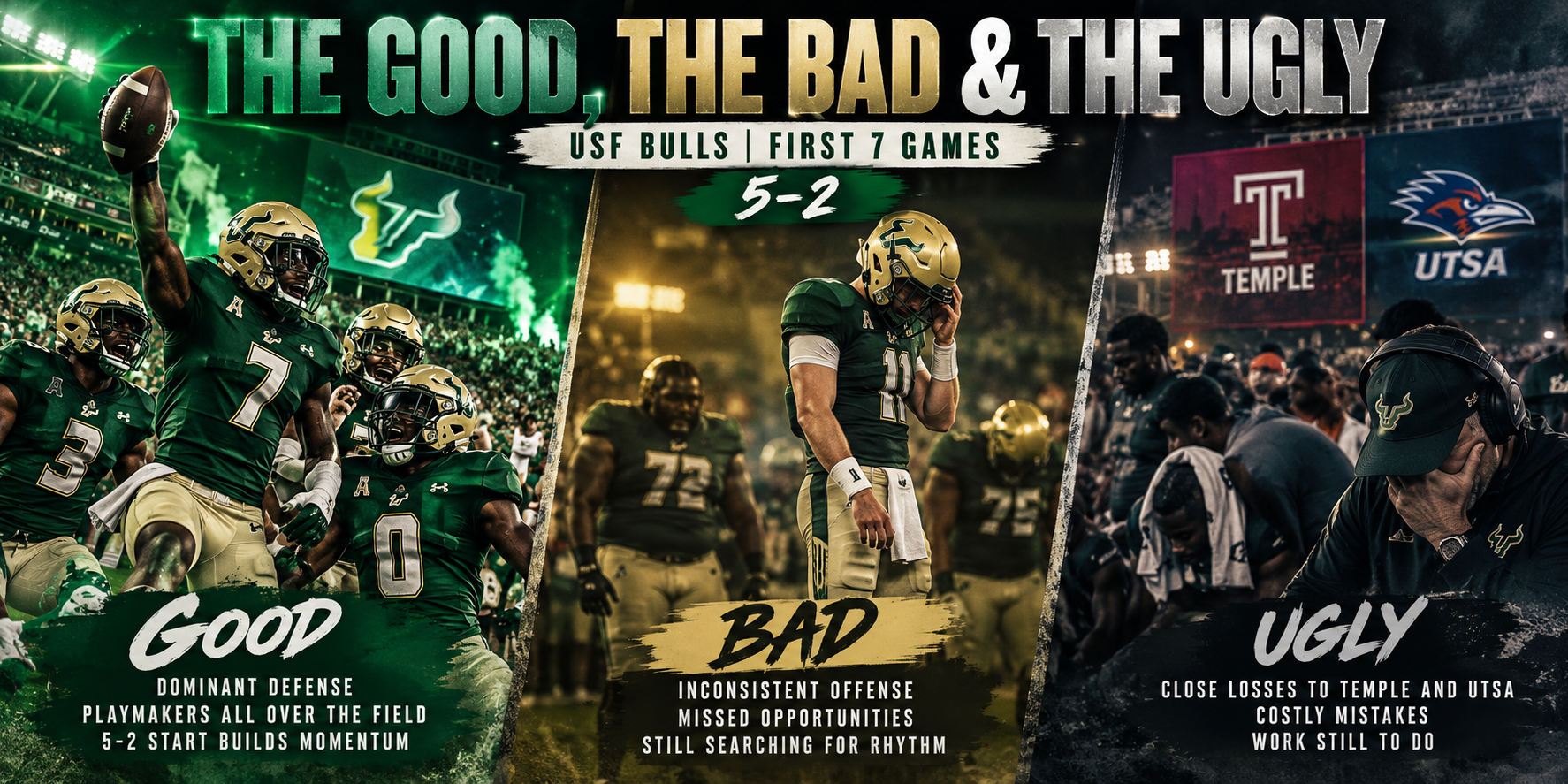
The South Florida Bulls have reached their bye week with five victories, two losses, and plenty of unanswered questions. First-year head coach Brian Hartline has guided USF to a 5-2 record through seven games. However, the Bulls’ record does not tell the entire story of their season. USF has displayed outstanding defense, inconsistent offense, and occasional moments of brilliance. The Bulls opened their season with four consecutive victories before suffering back-to-back American Conference losses. Fortunately, they bounced back with a 29-2 homecoming victory over Kent State. Now, Hartline must address several problems before the Bulls enter the most important stretch of their schedule.
USF averages 26.6 points per game while allowing just 15.1 points. Those numbers demonstrate the difference between the team’s offensive and defensive performances. The Bulls also finished their nonconference schedule undefeated for the first time since 2018. Nevertheless, their 1-2 conference record creates considerable pressure heading into the final five games. Here is a closer look at the good, bad, and ugly from USF’s first seven contests.
USF’s First Seven Games
| Date | Opponent | Result |
| ———— | —————- | ——– |
| September 5 | FIU | W, 19-9 |
| September 12 | at Army | W, 28-24 |
| September 19 | Delaware State | W, 59-17 |
| September 26 | at Bowling Green | W, 14-6 |
| October 3 | Temple | L, 13-17 |
| October 8 | at UTSA | L, 24-31 |
| October 17 | Kent State | W, 29-2 |
Source: USF Athletics official 2026 football schedule.
Game 1: USF 19, FIU 9 — Winning Ugly
USF opened the season against Florida International at Raymond James Stadium. The Bulls secured a 19-9 victory, giving Hartline his first win as USF’s head coach. However, the offense struggled to establish the explosive rhythm many fans expected. Quarterback Michael Van Buren Jr. began his tenure leading an offense that needed greater consistency. Meanwhile, the defense helped control the game and kept FIU from reaching double figures. That defensive performance provided an encouraging foundation for the season. Still, scoring only 19 points against FIU raised concerns about USF’s offensive ceiling. The Bulls earned the victory, but they left considerable room for improvement.
Game 2: USF 28, Army 24 — A Tough Road Victory
The Bulls traveled to West Point for their first American Conference matchup. Army presented a difficult challenge with its disciplined, run-oriented offense. However, USF escaped Michie Stadium with an important 28-24 victory. Van Buren connected with Joshua Porter on a beautiful 38-yard touchdown pass. That play demonstrated the quarterback’s ability to stretch defenses vertically. Meanwhile, the Bulls showed resilience against an opponent that specializes in controlling possession. Defensively, USF needed discipline against Army’s option attack. Although the Black Knights scored 24 points, the Bulls did enough to earn their first conference victory. The win improved USF’s record to 2-0 and provided valuable road experience. More importantly, the Bulls demonstrated they could survive a competitive conference contest.
Game 3: USF 59, Delaware State 17 — Offensive Explosion
The Bulls returned home and delivered their most explosive offensive performance of the season. USF dominated Delaware State 59-17, improving to 3-0. Running back D.J. Crowther played an important role in the offensive success. His physical running helped establish momentum against the Hornets. Meanwhile, the Bulls found opportunities to attack through the air. The offense finally displayed the scoring potential that fans expected from Hartline’s system. However, Delaware State presented a considerably different challenge than USF’s conference opponents. The Bulls needed to maintain that offensive production against stronger competition. Nevertheless, scoring 59 points provided confidence heading into another road matchup.
Game 4: USF 14, Bowling Green 6 — Defense Saves the Day
USF entered Bowling Green with an undefeated record. However, the offense struggled through one of its most frustrating performances. The Bulls failed to score during the first three quarters. Fortunately, their defense kept Bowling Green from building an insurmountable advantage. USF eventually rallied during the fourth quarter to secure a 14-6 victory. The win improved the Bulls to 4-0, but it also exposed significant offensive problems. The running game lacked consistency, while the passing attack struggled to create sustained drives. Meanwhile, the defense delivered another impressive performance. Holding Bowling Green to six points allowed the Bulls to survive an otherwise disappointing afternoon. However, relying on fourth-quarter rallies against struggling opponents cannot become a winning formula. The warning signs were becoming difficult to ignore.
Game 5: Temple 17, USF 13 — The First Major Disappointment
Temple arrived at Raymond James Stadium with an opportunity to end USF’s undefeated start. Unfortunately for Bulls fans, the Owls accomplished exactly that. USF suffered a frustrating 17-13 defeat despite another strong defensive performance. The Bulls managed only 108 offensive yards during the first half. Meanwhile, Temple established a 10-3 halftime advantage. Crowther scored on a one-yard touchdown run during the third quarter. Nico Gramatica later connected on a 49-yard field goal, giving USF a 13-10 lead.
However, the Bulls failed to protect that advantage. Temple marched 96 yards during the fourth quarter and scored the winning touchdown. Van Buren completed 17 of 32 passes for 205 yards. Crowther managed 68 rushing yards on 23 carries. Meanwhile, linebacker Grayson Howard recorded nine tackles, and C.J. Hicks added seven. The defense limited Temple to 274 total yards. Nevertheless, USF’s offense failed to deliver when the team needed another scoring drive. The loss also ended the Bulls’ nine-game home winning streak.
Game 6: UTSA 31, USF 24 — Another Heartbreaking Finish
USF traveled to San Antonio hoping to rebound against UTSA. The Bulls started impressively, building a 14-7 first-quarter advantage. Crowther opened the scoring with a 15-yard touchdown run. Meanwhile, Van Buren connected with Bryson Rodgers for a beautiful 42-yard touchdown. USF carried a 17-10 advantage into halftime. However, UTSA responded during the second half and eventually took a 23-17 lead. The Bulls refused to surrender. Van Buren engineered a 75-yard scoring drive and found Crowther for an 11-yard touchdown. Gramatica’s extra point gave USF a 24-23 lead with 1:56 remaining. Unfortunately, the defense could not finish the job.
UTSA running back A’Marion Peterson scored the winning touchdown with 15 seconds remaining. The Roadrunners added a two-point conversion to secure a 31-24 victory. Van Buren finished with 177 passing yards and two touchdowns. Crowther contributed 83 rushing yards and two total touchdowns. Meanwhile, Tavin Ward recorded nine tackles, while Ayden Jackson added eight. The loss highlighted USF’s inability to close out important conference games. For the second consecutive contest, a late defensive breakdown proved costly.
Game 7: USF 29, Kent State 2 — Defense Dominates Homecoming
The Bulls returned home desperate to end their two-game losing streak. However, their offense again struggled during the opening half. Kent State grabbed an early 2-0 lead after recording a safety. Then, C.J. Hicks delivered the game’s defining moment. The defensive standout recovered a fumble near the USF goal line. He raced 96 yards for a touchdown, completely changing the game’s momentum. His return tied the program record that Kayvon Webster established against Notre Dame in 2011. Meanwhile, Gramatica connected on field goals from 49 and 33 yards. Luke Kromenhoek scored on a one-yard quarterback run during the third quarter. Van Buren later found Cameron Seldon for a 36-yard touchdown.
The Bulls finished with a 29-2 victory, improving to 5-2. Van Buren completed 22 of 27 passes for 193 yards and one touchdown. Seldon contributed four receptions for 60 yards. Meanwhile, Michael Williams II recorded 1.5 sacks and two tackles for loss. The defense allowed only 228 total yards and prevented Kent State’s offense from scoring. However, USF generated just 271 total yards against a struggling opponent. The victory provided relief, but the offensive concerns remained.
The Good: Defense, Resilience, and Emerging Playmakers
USF’s defense deserves considerable praise through seven games. The Bulls have allowed just 106 total points, averaging 15.1 per contest. That production ranks among the nation’s strongest scoring defenses. Furthermore, the defense has prevented opposing offenses from scoring touchdowns in two games. Hicks has emerged as one of the team’s most impactful defensive players. His 96-yard touchdown against Kent State provided the season’s most memorable defensive highlight. Meanwhile, Howard continues to provide leadership at linebacker. Williams has also strengthened the pass rush, recording four sacks through seven games.
Offensively, Crowther has demonstrated his ability to produce important touchdowns. Van Buren has occasionally displayed impressive accuracy on deep passes. Additionally, Gramatica remains a valuable weapon in close contests. Perhaps most importantly, the Bulls have demonstrated resilience despite their offensive struggles.
The Bad: Offensive Inconsistency and Injuries
The biggest disappointment involves USF’s offense. Hartline arrived with a reputation for developing talented offensive players. However, his first Bulls offense has struggled to establish consistent production. USF averages 26.6 points, but Delaware State accounts for 59 of those points. The Bulls have scored only 13.6 points per game against their five FBS opponents outside Army and UTSA. Furthermore, the running game has struggled behind an offensive line dealing with injuries. USF has managed only 303 rushing yards during its last three contests. The passing game also lacks consistency.
Although Van Buren has delivered several impressive deep throws, the offense rarely attacks vertically. Injuries have complicated the situation. The Bulls started the same offensive line in consecutive games for the first time against Kent State. Hartline must use the bye week to improve protection, rushing efficiency, and offensive execution.
The Ugly: Blown Leads and Missed Opportunities
The losses against Temple and UTSA remain the most frustrating moments of USF’s season. Both games offered opportunities for important conference victories. However, late defensive breakdowns allowed opponents to escape. Temple marched 96 yards for the winning touchdown. UTSA followed with a 75-yard scoring drive during the final two minutes. Those possessions exposed problems with defensive execution during critical moments.
Meanwhile, the offense failed to produce enough points against Temple. The Bulls also struggled to sustain momentum after halftime against UTSA. Additionally, USF has gone six consecutive games without a defensive interception. That statistic raises concerns about the team’s ability to generate takeaways through the passing game. The Bulls must improve their late-game execution before facing the American Conference’s stronger opponents.
What Comes Next for Hartline and the Bulls?
USF enters its bye week with an opportunity to correct several important problems. The Bulls return to action October 31 against UAB at Raymond James Stadium. That matchup begins a challenging five-game stretch against American Conference opponents. Hartline must prioritize offensive consistency and better execution inside scoring territory. Meanwhile, the defense needs to continue its impressive performance while improving late-game discipline. The Bulls also need healthier offensive linemen to establish a more dependable rushing attack.
Fortunately, USF still controls its opportunity to finish the regular season strongly. Five victories through seven games provide a solid foundation. However, a 1-2 conference record leaves little room for additional mistakes. The difference between a successful season and a disappointing finish could depend on offensive improvement.
Final Thoughts: Five Wins, but Plenty of Work Ahead
The Bulls deserve credit for opening Hartline’s tenure with five victories. Their defense has consistently kept them competitive, even when the offense struggles. However, the record also disguises several significant weaknesses. USF cannot continue relying on defensive touchdowns, field goals, and late rallies to survive. The Bulls need Van Buren to become more consistent and Crowther to find additional running lanes. Meanwhile, Hartline must develop an offensive identity that produces sustained drives against conference competition. The losses against Temple and UTSA demonstrated how quickly promising seasons can change.
Nevertheless, the victory over Kent State provided momentum heading into the bye week. The next five games will reveal whether USF can compete for a strong conference finish. For now, the Bulls have accomplished enough to remain optimistic. However, five wins through seven games represent a promising start, not proof that USF has arrived. Hartline and his players must turn that promise into consistent football before the season slips away.



Author Profile

-
Bradley Walker (VP) and Head of our Florida operations for NGSC Sports, bringing extensive experience across collegiate, professional, and amateur athletics. His coverage spans USF Athletics, including football, baseball, lacrosse, and softball, as well as University of Tampa baseball.
Bradley also provides coverage of minor league baseball with the Clearwater Threshers and Major League Baseball with the Tampa Bay Rays. On the national stage, he covers college football bowl games and conference championship matchups, along with premier golf events across the PGA Tour, LIV Golf, and LPGA Tour.
In addition to his reporting work, Bradley is the play-by-play announcer for Pinellas Park High School Patriots football, lending his voice and insight to Friday night lights.
He is also an active podcast host and contributor, serving as a host on The Walker Report, where he delivers in-depth sports analysis, interviews, and coverage across multiple levels of competition.
Latest entries
 FootballOctober 22, 2026Florida Gators Football: Seven Games, Five Wins, and a Wild SEC Ride
 AAC FootballOctober 22, 2026USF Football: The Good, Bad, and Ugly Through Seven Games
 HockeyOctober 22, 2026Dylan Larkin Trade Rumors: 10 Teams Now in the Mix
 HockeyOctober 22, 2026Lightning vs. Avalanche: Kucherov Chases History as Tampa Bay Eyes Fourth Straight Win
About the Author