Photo credit: [Patrick Barron]
 0
0
 0
0
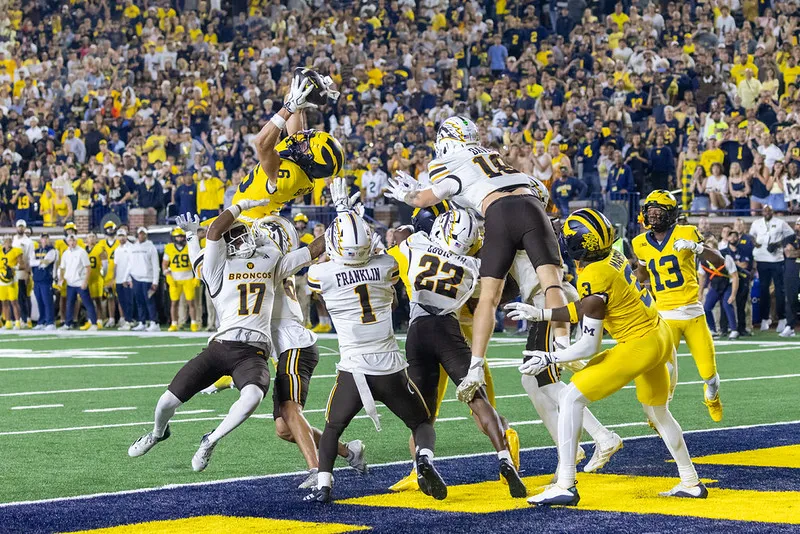
In one of the most surreal, controversial finishes in modern college football history, No. 16 Michigan escaped with a 13–12 victory over Western Michigan at The Big House. The Broncos were on the turf celebrating a program-defining upset after freshman quarterback Bryce Underwood’s initial Hail Mary attempt fell incomplete with 0:00 showing on the scoreboard and on the NBC broadcast.
Moments later, replay officials intervened, added one second back to the game clock, and gave Michigan one final snap. Underwood then connected with J.J. Buchanan for a miraculous 47-yard walk-off touchdown.

Why Broadcast Clocks Do Not Count: Fans across the country were left baffled as NBC’s clock graphic clearly hit zero while the football was still in mid-air. However, NCAA football rules explicitly state that the television graphic is merely an unofficial estimation generated by the network.
The official game clock is controlled inside the stadium by an operator acting on the field officials’ whistles and signals. During video reviews, replay officials use high-speed Hawk-Eye camera feeds directly synced to the stadium’s primary clock. The Big Ten released a statement clarifying that Western Michigan defender Micah Davis made contact with the ball from an out-of-bounds position with exactly one second remaining on the direct stadium clock feed, automatically deadening the play under NCAA Rule 4-2-3-a.
The Conspiracy Theories: “Was the Fix In?” Because millions of viewers watched NBC rules analyst Terry McAulay voice utter disbelief live on air, narrative engines exploded. Critics and fans immediately raised eyebrows regarding power-conference favoritism:
- Blue-Blood Protection: Skeptics argued that a Big Ten officiating crew found a loophole to save a top-20 brand and new head coach Kyle Whittingham from an embarrassing season-opening loss to a MAC program.
- The “Invisible Second”: Because the visual evidence presented on the national TV broadcast did not align with the replay booth’s ruling, critics questioned why synced footage wasn’t immediately shared on screen to neutralize outrage.
How This Affects College Football Moving Forward
This finish exposes a glaring transparency gap between modern sports broadcasting and elite officiating technology. Moving forward, expect three immediate shifts:
- Mandatory Broadcast Clock Synchronization: Networks and conferences will face immense pressure to standardize live TV clock feeds directly to stadium clock outputs to prevent visual discrepancies during high-stakes reviews.
- Replay Transparency Protocols: Replay booths will likely be required to release the exact side-by-side camera angles and clock feeds used to overturn end-of-game plays in real-time to mitigate sports-betting and integrity backlash.
- Heightened Scrutiny on Officiating: The Big Ten and NCAA will face mounting calls for independent auditing of clock-stoppage reviews, especially when a non-power program is deprived of a major victory.
In the End
Most of us will not remember the win; we will think about how the Broncos got robbed. All clocks said zero except one phantom clock that changed the outcome. This cannot happen in a day and age where there are so many questions in college football about the rules.
Yes, it looks like this was within the rules, but this was a major screw-up by the NCAA.


Author Profile

- CEO NGSC Sports
Latest entries
 NCAAFSeptember 7, 2026How Michigan Survived, Why Broadcast Clocks Lie, and the Theories
 FCSSeptember 6, 2026FCS Football Week 1: Bobcats Open Title Defense, Shockers, and FCS Over FBS Winners
 WNBASeptember 6, 2026Cathy Engelbert to Retire as WNBA Commissioner Following Transformative, Tumultuous Reign
 FIBA World CupSeptember 5, 2026Dominant Group-Stage Statement: USA Women Outclass China 94–71 at FIBA World Cup
About the Author