 0
0
 0
0
Understanding Draft Capital Over Expectation (DCOE)
In the high-stakes ecosystem of NFL roster architecture, Draft Capital Over Expectation (DCOE) serves as the definitive quantitative audit of organizational efficiency. Unlike subjective “draft grades” that rely on localized scouting biases, DCOE measures the “wisdom of crowds” by benchmarking actual draft execution against the consensus market valuation derived from aggregate mock drafts and industry big boards. Strategically, DCOE is a measure of surplus value capture; it quantifies the delta between a player’s expected draft slot and their actual selection point, directly impacting a franchise’s APY cap percentage—the ultimate currency of roster construction.
A lower or negative DCOE denotes superior value acquisition, indicating that a front office secured talent later than the market expected, thereby maximizing the return on the rookie wage scale. Conversely, high positive DCOE scores signal “process arrogance,” where teams spend premium capital on assets that likely could have been secured at a significant discount.
The 2026 draft cycle exposed a widening chasm in capital management efficiency across the league, as illustrated in the table below.
2026 NFL Draft Efficiency Rankings: Value Performance
| Efficiency Rank | Team | DCOE (Negative = Efficient) |
|---|---|---|
| 1 (Most Efficient) | Washington Commanders | -1.71 |
| 2 | Carolina Panthers | -1.65 |
| 3 | Indianapolis Colts | -0.90 |
| 4 | Cincinnati Bengals | -0.81 |
| 5 | New York Jets | -0.78 |
| … | … | … |
| 28 | Arizona Cardinals | 1.90 |
| 29 | Jacksonville Jaguars | 1.93 |
| 30 | Houston Texans | 2.18 |
| 31 | Los Angeles Rams | 2.18 |
| 32 (Least Efficient) | San Francisco 49ers | 3.14 |
Note: DCOE is calculated relative to total draft capital expenditure. Negative values denote superior value acquisition.
The following analysis details how the Washington Commanders transitioned into a premier value-hunter, while the San Francisco 49ers continue to suffer from a systemic erosion of draft equity.
Case Study in Maximization: The Washington Commanders’ 2026 Strategy
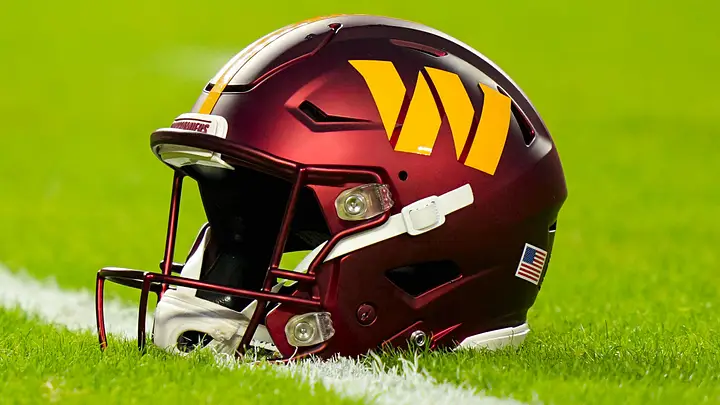
The Washington Commanders’ ascent to the #1 DCOE ranking marks a fundamental shift in their roster-building philosophy. After the 2023 and 2024 cycles were marred by consistent reaches, the 2026 regime pivoted to a strategy of disciplined “equity capture.” By refusing to draft in a vacuum, Washington exploited the variance between internal boards and consensus valuations to maximize a limited pool of capital.
Washington’s strategy was defined by “making more out of less”—identifying high-floor prospects during the convex decay of variance in the mid-to-late rounds. This allowed them to build substantial roster depth without the luxury of top-tier volume.
Key Value Acquisitions: Captured Equity
- Sonny Styles (RD 1, Pick 7): A consensus top-five blue-chip prospect. Securing Styles at #7 represents a significant capture of first-round surplus value.
- Joshua Josephs (RD 5, Pick 146): While the market expected Josephs to be off the board by pick #77, Washington waited, capturing a Day 2 talent with mid-Day 3 capital.
- Kaytron Allen (RD 6, Pick 186): Allen’s expected slot of #130 suggested a fourth-round value. By securing him at #186, Washington leveraged a 56-pick disparity to bolster their backfield at a near-minimum APY cap hit.
By adhering to this framework, Washington avoided the pitfalls of drafting in isolation, a risk that frequently leads to the systemic overpayment observed in non-efficient organizations.
The Price of “Process Arrogance”: Analyzing the San Francisco 49ers’ Deficit
San Francisco’s #32 DCOE ranking is a symptom of a systemic process failure. This is not a statistical outlier but a continuation of a multi-year trend of bottom-tier efficiency (#31 in 2023, #28 in 2024, #31 in 2025). The 49ers operate with an organizational “blind spot” likely born from the “Luck vs. Process” dynamic; high-profile late-round successes like George Kittle (5th Round) and Brock Purdy (7th Round) have seemingly emboldened the front office to ignore consensus market value entirely.
This arrogance is most visible in their historical mismanagement of mid-round running back capital. Since 2017, the 49ers have repeatedly reached for backs who failed to yield a return on investment: Joe Williams (2017), Trey Sermon (2021), Tyrion Davis-Price (2022), Isaac Guerendo (2024), and Jordan James (2025).
2026 Systematic Reaches
- De’Zhaun Stribling (WR): Selected at #33 despite a consensus expectation of #99. Drafting a “poor route runner” two rounds early suggests a failure to learn from previous WR evaluation errors.
- Kaelon Black (RB): Expected at #214 but taken at #90. This pick epitomizes the 49ers’ cycle of overpaying for mid-round backfield traits that the market values as late-round filler.
- Enrique Cruz Jr. (OT): Drafted at #179 with an expected slot of #280. Selecting a player nearly 100 picks before his projected UDFA status is a textbook example of capital hemorrhage.
Strategic Impact: Drafting against consensus creates a structural disadvantage. By paying “retail” prices for talent available at a “discount,” San Francisco fails to maximize the surplus value of rookie contracts. This limits their Super Bowl window by forcing an over-reliance on expensive veteran contracts and high-variance “luck” to sustain roster depth.
Theoretical Framework: Nonlinear Value and the “Eliteness” Trap
NFL front offices often face a tension between “Expected Performance” and “Right-Tail Probability.” Research into Nonlinear Draft Value suggests that GMs are often willing to sacrifice DCOE to chase “Eliteness.” Because elite players have an outsize influence on Super Bowl win probability, their value is not linear; a player in the 99th percentile of outcomes is exponentially more valuable than one in the 80th.
The “r ≈ 0.15” Threshold and the QB Premium
The trade market closely matches a right-tail probability cutoff of r ≈ 0.15 (representing players whose APY cap percentage exceeds 15%). This is an incredibly rare tier of performance; in the 2013-2023 dataset, only 16 players (0.57% of all draftees) satisfied this threshold. GMs reach because the scarcity of these “ultra-elite” outcomes justifies the premium. This logic — accepting a high-variance, low-frequency bet in pursuit of asymmetric reward — appears across competitive domains. It’s the same calculus behind free spin no deposit offers, where players chase outsized returns without committing upfront capital.
- The LA Rams and Ty Simpson: The Rams reached for Simpson at #13 (Expected #38). While Simpson offers a “fat right tail,” the move highlights a strategic conflict: Simpson provides no utility for a 2026 “win-now” window (a team that reached the NFC Championship without him), representing a pure bet on future eliteness at the cost of immediate roster help.
- Arizona’s Jeremiyah Love: Taking an RB at #3 overall is a positional value pitfall. Love’s $54 million guarantee is $20 million more than any rookie RB in NFL history, requiring him to be a top-3 league-wide performer immediately just to break even on the APY cap hit.
Successful architects use an S-Curve Valuation over a Linear Outcome Value (g-line), recognizing that moving from a median starter to a franchise-altering star is worth the risk of a high-DCOE reach, provided it is limited to high-impact positions like Quarterback.
Historical Context: Patterns of the “Elite Steal” (2016-2026)
True “steals” are simply prospects whose “right-tail” outcomes were mispriced by the consensus. These players are often overlooked due to an over-reliance on combine metrics or “mystery upside” traits. Analyzing the last decade of elite value (Dak Prescott, Maxx Crosby, Fred Warner) reveals a specific profile of the mispriced star.
Profile of an Elite Steal
- Consistent College Production over Combine Metrics: Cooper Kupp (RD 3, 2017) is the benchmark. Despite record-breaking production at Eastern Washington, he was labeled a “Michael Crabtree” type who lacked “suddenness” and “speed.” Evaluators favored 40-yard dash times over his elite hands and route precision.
- High Football IQ/Intelligence: Steals like Dak Prescott (RD 4, 2016) and Brock Purdy (RD 7, 2022) were overlooked for physical ceilings but succeeded due to processing speed and composure.
- Versatility and Scheme Fit: Players like Fred Warner and George Kittle were identified as “jack-of-all-trades” prospects whose versatility was incorrectly viewed as a lack of a primary position.
The “Quarterback Steal” remains the ultimate tool for capital management. Finding a starter like Prescott or Purdy outside the first round allows a team to reallocate nearly 15-20% of their total cap space to other elite positions, creating a roster that is mathematically superior to those paying top-of-market QB wages.
Recommendations for Future Capital Management
The 2026 NFL Draft demonstrates that while the pursuit of “eliteness” is a valid strategic driver, consistent deviation from consensus DCOE creates a structural deficit that even “luck” cannot permanently overcome. Organizations must balance the aggressive pursuit of right-tail outcomes with the disciplined capture of market value to ensure long-term roster sustainability.
Actionable Commands for NFL Front Offices
- Command 1: Leverage the “Wisdom of Crowds” to identify value “pockets.” Specifically in Rounds 4-6, where variance is high, teams should target high-production prospects with mispriced athletic measurables to maximize late-round equity.
- Command 2: Avoid Positional Value Pitfalls. Never commit historic capital to low-impact positions. Arizona’s $54 million guarantee for a rookie RB at #3 represents a $20 million premium over the market record—a cost that rarely yields a positive ROI.
- Command 3: Balance “Chasing Eliteness” with “Securing Surplus Value.” While a reach for a franchise QB can be justified by the “fat right tail” of the position, systemic reaching across the entire board (the San Francisco model) leads to inevitable roster erosion.
The legacy of the 2026 class will be defined by the efficiency of the Washington Commanders and the cautionary tale of the San Francisco 49ers. In the modern NFL, the draft is not just about finding players; it is about the precise management of capital against the reality of the salary cap.



Author Profile

Latest entries
 FashionSeptember 19, 2026Will the 2026 Rugby Kit Launches Prioritise Durability Over “Lightweight” Performance?
 CryptocurrencySeptember 18, 2026Top Crypto Casino Bonuses to Claim in 2026
 The HubSeptember 17, 2026Why More Runners Are Ditching Overloaded Pockets for Smarter Running Storage
 The HubSeptember 14, 2026Why the Flywheel and not the Engine Decides What a Wood Chipper Can Swallow
About the Author