 0
0
 0
0
An outdoor sporting event can take up far more of the day than the competition itself.
You might arrive at 7 a.m. for a 9 a.m. start, wait several hours between events, then come back for another round in the afternoon. Trail races, youth outdoor championships, weekend tournaments and two-day events can keep athletes, families and support crews at or near the venue all day.
What often gets underestimated is not how much gear to bring, but how to manage the hours between events. Where do worn clothes go? Can you find the gear for the next event quickly? If the weather changes, is there somewhere to store equipment and take a short break?
If event rules allow shelters in designated areas, or the weekend includes a nearby campsite, a well-organized basecamp — a fixed area for resting, changing clothes, storing supplies and organizing gear — gives those needs a clear place.
The Time Between Events Takes More Planning Than It Seems
One of the challenges of a long event day is how fragmented the schedule can become.
Finishing one event does not always mean leaving. There may be another round, an awards ceremony, a teammate’s event or an early start the next morning. People move between the competition area, rest area, vehicles and campsite, while gear gets picked up and put down throughout the day.
A temporary basecamp is not about making the venue feel like home. It gives those gaps in the schedule a fixed point. Dry clothes, water, backup gear and personal items all have a place, while food should be handled separately according to venue rules and proper storage needs.
The first step, however, is always checking the event and venue rules. Some facilities limit tent size, stakes or setup areas, so a shelter should never be assumed to be allowed near the competition area.
A Basecamp Needs Good Flow, Not More Gear
For a long outdoor event, it is easy to confuse packing everything with organizing it well.
Once the day starts, some items are used far more often than others. Water, jackets, towels and gear for the next event may be picked up several times in an hour. Backup shoes, next-day items or rarely used tools do not need the same easy access.
A more practical setup keeps frequently used items near the entrance, leaves room open for resting and changing, and gives wet shoes, muddy gear and worn clothing their own area. It does not require an elaborate storage system. The goal is simply to keep different types of gear from ending up in the same pile.
When several people share the same basecamp, less time spent digging through bags and looking for gear means less unnecessary back-and-forth between events.
The Tent Has to Work Throughout the Day
A sports basecamp is used differently from a tent that is mainly there for sleeping overnight.
People may be coming and going all day. Someone may return to change clothes, someone else may stop for supplies, and another person may sit down for a few minutes before heading back to the competition area. Capacity is only part of the question. The entrance needs to be easy to use, there should be enough room to stand and organize gear, and the main walkway should stay clear after chairs, bags and backup equipment are inside.
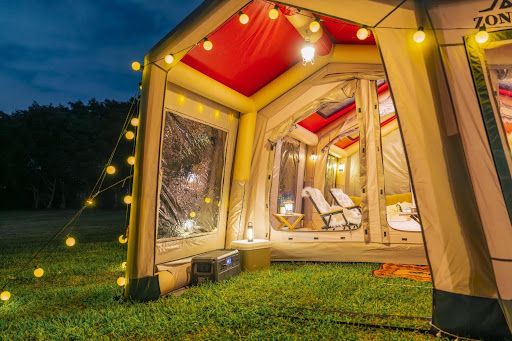
If event rules allow a temporary basecamp, inflatable tents can reduce some of the assembly involved with traditional tent poles. But for an event-day setup, the entrance, standing room and interior flow still matter, especially when several people will be moving in and out throughout the day.
The goal is not simply to use the biggest tent available. Both the setup and the interior need to work with the pace of the event.
In Cold Weather, Start with Dry Clothes and Warm Layers
For outdoor events that run from early morning into the evening, temperature, wind and how the body feels after activity can change noticeably over the course of the day.
Sitting around in damp clothes after competing feels very different from changing into dry clothing and adding an appropriate warm layer. A cold-weather basecamp should therefore make it easy to change clothes, keep wet and dry items separate and reach warm layers when needed, rather than turning first to an additional heat source.
If a two-day event includes an overnight stay at a nearby campground, a hot inflatable tent is a separate camping system that needs its own assessment. Any use of a heat source requires checking the tent design, equipment compatibility, ventilation and exhaust requirements, as well as campground rules. It should not be treated as a standard event shelter with heat simply added to it.
For the daytime event itself, changing into dry clothing and adding warm layers remains the more direct approach.
Keep Shared Space and Support Space Separate
When families, friends or a small support crew attend an event together, a basecamp can quickly become a place for resting, eating, changing clothes, storing equipment and talking.
The problem is not always a lack of room. It is that everything starts happening in the same place. One person sits down to rest while someone else starts searching through equipment. Food, gloves and damp clothes end up on the same table, and the area quickly becomes harder to manage.
Among large inflatable tents for camping, the ZONKOO Draco Plus uses 252 sq ft of total usable space across a main tent and attached gazebo. During a group event weekend, the main tent can handle changing, rest and personal gear, while the gazebo can hold tables, supplies and shared daytime activities, keeping different uses from competing for the same space.
The point of that separation is not to create more “rooms.” It is to give different activities their own place so the same area does not have to be rearranged throughout the day.
A Good Basecamp Should Mean Less Back-and-Forth
Outdoor events come with plenty of things that cannot be fully controlled. Schedules can run late, weather can change and the final event may not finish exactly when expected.
A basecamp cannot control any of that, but it can reduce unnecessary searching and back-and-forth. Dry clothes, gear for the next event and personal items have fixed places, so changing clothes or grabbing backup equipment does not mean searching between the competition area, vehicle and rest area. Everyone also knows where to meet and take a break.
From the first event to the last, the competition is not the only part of the day that demands energy. Keeping the hours around it organized makes it easier to save more attention for the moment it is time to compete.



Author Profile

Latest entries
 The HubOctober 23, 20266 Best Places to Buy a Golf Simulator Projector: The 2026 Shortlist of Retailers Worth Buying From
 TechOctober 23, 2026Hard Disk Structure in Operating System
 SportsOctober 23, 2026How Korean Sports Fans Follow Football, Basketball, Baseball, and Major Sporting Events Online
 CasinoOctober 19, 2026Low-Deposit Online Casinos: What Canadian Players Should Know
About the Author