Photo Credit: YouTube
 0
0
 0
0
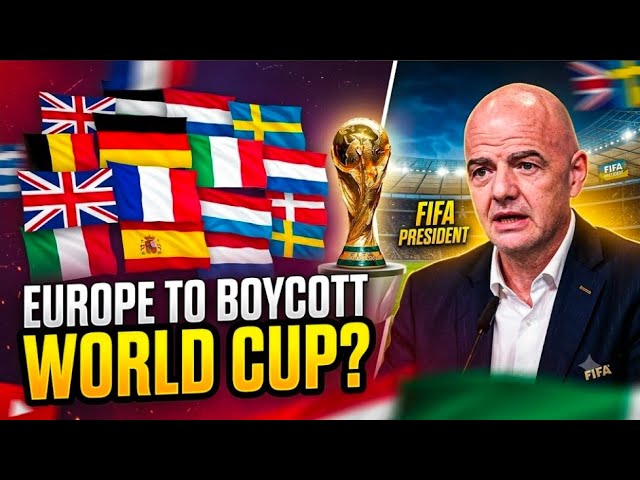
UEFA’s 55 member nations have agreed to boycott FIFA competitions after FIFA revealed plans to sell part of its biggest tournaments to private investors. The decision followed an emergency virtual meeting on Thursday. European football leaders strongly opposed FIFA president Gianni Infantino’s proposal. They argued that football’s governing bodies should never treat the sport like a commercial asset. As a result, UEFA reached a united position against the plan. The boycott would first affect the 2027 FIFA Women’s World Cup in Brazil. It could also impact the 2030 FIFA World Cup. Spain, Portugal and Morocco will jointly host that tournament. In addition, South America will stage several centenary matches to celebrate the competition’s 100th anniversary. If UEFA follows through, many of the world’s strongest national teams would miss both events.
FIFA recently confirmed plans to create a new company called FIFA Forward Enterprises. This organization would oversee the World Cup, Club World Cup and other major FIFA competitions. FIFA wants to sell a 21 percent minority stake in the company. The governing body hopes to raise £3.2 billion through the sale. FIFA also plans to distribute some of that money among its 211 member associations. However, the proposal still requires approval. FIFA’s 211 member associations must vote on the plan. The FIFA Council must also approve it before the sale can move forward. Until then, the proposal remains under review despite FIFA’s public announcement.
Reports from several media outlets revealed additional details about the proposal. According to those reports, FIFA president Gianni Infantino wants private investors to purchase ownership stakes in the new company. One reported investor includes Thrive Capital, the venture capital firm founded by Joshua Kushner. Kushner is the brother of Jared Kushner, who married Ivanka Trump, daughter of U.S. President Donald Trump. Reports also stated that officials within the Trump administration know about the proposal. Donald Trump and Gianni Infantino built a close working relationship before and during the 2026 FIFA World Cup. That connection has created additional public attention around the reported investment discussions. Still, no final agreement has received official approval.
Under the proposed structure, FIFA would continue holding the majority ownership of FIFA Forward Enterprises. Meanwhile, every one of FIFA’s 211 member associations would receive an ownership stake alongside private investors. The company would manage FIFA’s most valuable men’s and women’s competitions. Those events include both the World Cup and the Club World Cup. Another report outlined Infantino’s future plans if member associations approve the proposal. His current term as FIFA president ends in 2031. Afterward, he reportedly hopes to become commissioner of the new company. Reports suggested he could receive a salary comparable to NFL commissioner Roger Goodell. Goodell currently earns about $64 million annually. FIFA responded by saying no discussion has finalized that role or any future salary.
FIFA defended the proposal by saying it wants to strengthen football worldwide. The organization described the investment plan as part of a broader consultation process. FIFA also stated it regularly reviews innovative projects that could increase funding for football development. Officials believe additional investment could create more opportunities for member associations around the world. Financially, FIFA already operates from a strong position. The organization expects approximately $15 billion in revenue during the 2022 through 2026 World Cup cycle. That enormous revenue makes FIFA attractive to private investment firms. Investors often seek businesses that generate consistent global income. The World Cup remains one of the world’s most profitable sporting events.
Many critics worry that private investors would focus more on profits than sporting traditions. Some believe investors would push for larger tournaments and more frequent competitions. Those changes could increase commercial revenue. However, they could also place greater demands on players, clubs and national teams throughout an already crowded international calendar. UEFA released one of the strongest responses against FIFA’s proposal. The organization declared that football’s governance should never become a financial asset for private sale. UEFA also criticized the lack of transparency surrounding the proposal. Leaders questioned who would financially benefit from the deal and how those decisions would affect the future of global football.
UEFA further argued that nobody owns football. Officials insisted FIFA has no authority to sell the game’s soul or governance. They urged national associations, leagues, clubs, players, supporters and governments to oppose the proposal. Their statement reflected widespread concern across European football. Concacaf also expressed concern after reports surfaced about the investment proposal. While the confederation stopped short of supporting a boycott, officials described the situation as deeply concerning. That reaction suggested opposition extends beyond Europe. Other football organizations could closely monitor future developments before deciding their own positions.
This proposal also resembles previous attempts by Infantino to attract outside investors. In 2018, he pursued a reported $25 billion agreement involving Japan’s SoftBank and Saudi Arabia’s sovereign wealth fund. The plan aimed to launch new international football competitions. However, the proposal collapsed after it failed to receive enough support from football stakeholders. Infantino also explored other commercial opportunities in recent years. Reports indicated he discussed creating a FIFA streaming service with former United States Treasury Secretary Steven Mnuchin. Those discussions never produced a finalized project. Even so, they highlighted FIFA’s continuing interest in expanding its commercial business.
The latest proposal now represents one of the biggest governance debates in modern football. Supporters believe new investment could increase funding and grow the sport globally. Critics fear commercial interests could outweigh football’s traditions and competitive integrity. The coming vote among FIFA’s 211 member associations will likely determine whether the proposal moves forward or faces the same fate as previous investment plans.



Author Profile

-
Bradley Walker (VP) and Head of our Florida operations for NGSC Sports, bringing extensive experience across collegiate, professional, and amateur athletics. His coverage spans USF Athletics, including football, baseball, lacrosse, and softball, as well as University of Tampa baseball.
Bradley also provides coverage of minor league baseball with the Clearwater Threshers and Major League Baseball with the Tampa Bay Rays. On the national stage, he covers college football bowl games and conference championship matchups, along with premier golf events across the PGA Tour, LIV Golf, and LPGA Tour.
In addition to his reporting work, Bradley is the play-by-play announcer for Pinellas Park High School Patriots football, lending his voice and insight to Friday night lights.
He is also an active podcast host and contributor, serving as a host on The Walker Report, where he delivers in-depth sports analysis, interviews, and coverage across multiple levels of competition.
Latest entries
 The HubSeptember 30, 202611-Year-Old British Chess Star Makes History
 FootballSeptember 30, 2026NFL Week 3 Winners and Losers: Purdy, Bowers Shine
 FootballSeptember 30, 2026NFL Week 3 Winners and Losers: Upsets Shake Up the League
 SportsSeptember 30, 2026Protect College Sports Act Clears Senate, House Awaits
About the Author