Photo Credit: Yahoo Sports
 0
0
 0
0
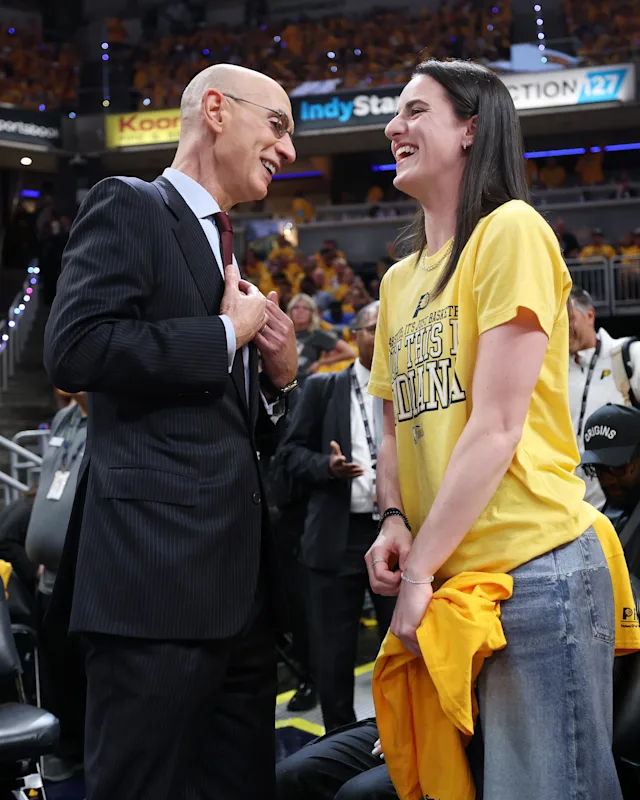
NBA Commissioner Adam Silver believes the ongoing discussion surrounding Caitlin Clark has moved far beyond basketball. Instead, he says the Indiana Fever star has become the center of political and cultural debates that overshadow her performance on the court. Silver addressed the topic during an onstage conversation with Andrew Ross Sorkin at the Game Plan Summit, presented by CNBC and Boardroom. He explained that the recent controversy involving Clark and Phoenix Mercury forward Alyssa Thomas represents a much larger issue than a single officiating decision.
According to Silver, people have shifted the conversation away from basketball. He believes many debates involving Clark now focus on politics and social issues instead of her development as one of the WNBA’s brightest young stars. “I have come to know Caitlin really well,” Silver said during the event. He praised Clark as both an outstanding player and an impressive person. Silver added that Clark simply wants to improve her game and compete at the highest level. However, he believes outside discussions continue to place unnecessary pressure on the former Iowa standout. Silver described Clark as a “political football” and said the constant debates surrounding her have become unfair.
He also emphasized that the controversy surrounding a recent on-court incident should not revolve around officiating alone. Instead, he argued that larger cultural discussions have attached themselves to Clark throughout her professional career. The incident occurred during the Indiana Fever’s June 24 game against the Phoenix Mercury. During the second quarter, Alyssa Thomas made contact with her fist to Clark’s throat while defending a play. Game officials did not call a foul during live action. However, the WNBA later reviewed the play and upgraded it to a flagrant foul. League officials also suspended Thomas for one game after determining she had recklessly made contact with her fist.
Thomas later explained that she never intended to hit Clark. She called the play accidental and rejected suggestions that she deliberately targeted the Fever guard. Unfortunately, the fallout extended well beyond basketball. Thomas revealed that she received death threats after the incident. She also said people directed racial slurs toward her across social media. Furthermore, Thomas criticized WNBA Commissioner Cathy Engelbert. She believed the league should have done more to publicly defend its players from harassment and abusive messages. Clark quickly condemned the threats directed at Thomas. Fever head coach Stephanie White also spoke out against the hateful comments. Both stressed that disagreements on the court should never lead to personal attacks away from basketball.
Even with those public statements, debates surrounding Clark have continued throughout her WNBA career. Since entering the league, Clark has transformed the WNBA’s visibility. Her arrival has fueled major increases in ticket sales across the league. Television ratings have also climbed as more fans tune in to watch Fever games. Many arenas have sold out when Indiana visits. Television networks have also featured Clark and the Fever in more nationally televised games because of the increased demand. Still, much of the national conversation has focused on issues beyond basketball. Discussions involving Clark frequently center on race, officiating, physical play, and politics instead of her on-court accomplishments.
Silver acknowledged that reality during his appearance. He argued that the focus on one controversial play ignores Clark’s continued growth as a player. “I don’t even think it’s fair to her that this has become a separate storyline about one foul,” Silver said. At the same time, Silver acknowledged that the WNBA can still improve its officiating. He openly admitted that better officiating remains an important goal for the league. “Do we need to improve WNBA officiating? No doubt about it,” Silver said.
His comments recognize two separate issues. First, the league should continue improving officiating consistency. Second, Clark should not carry the weight of broader political debates every time controversy surrounds one of her games. As Clark continues her career, she remains one of the biggest attractions in professional basketball. Her popularity continues to boost attendance, television audiences, and overall interest in the WNBA. Silver hopes those conversations eventually return to basketball. He believes Clark deserves the opportunity to focus on improving her game rather than serving as the center of ongoing cultural debates.



Author Profile

-
Bradley Walker (VP) and Head of our Florida operations for NGSC Sports, bringing extensive experience across collegiate, professional, and amateur athletics. His coverage spans USF Athletics, including football, baseball, lacrosse, and softball, as well as University of Tampa baseball.
Bradley also provides coverage of minor league baseball with the Clearwater Threshers and Major League Baseball with the Tampa Bay Rays. On the national stage, he covers college football bowl games and conference championship matchups, along with premier golf events across the PGA Tour, LIV Golf, and LPGA Tour.
In addition to his reporting work, Bradley is the play-by-play announcer for Pinellas Park High School Patriots football, lending his voice and insight to Friday night lights.
He is also an active podcast host and contributor, serving as a host on The Walker Report, where he delivers in-depth sports analysis, interviews, and coverage across multiple levels of competition.
Latest entries
 BasketballSeptember 15, 2026Chinese Mavericks Take Aim at College Basketball
 SportsSeptember 15, 2026Which Fall Sports Can Take Kids to College?
 SportsSeptember 15, 2026Youth Sports Costs Are Out of Control
 UFCSeptember 15, 2026Tom Aspinall Vacates UFC Heavyweight Title After Eye Injury
About the Author