 1
1
 0
0
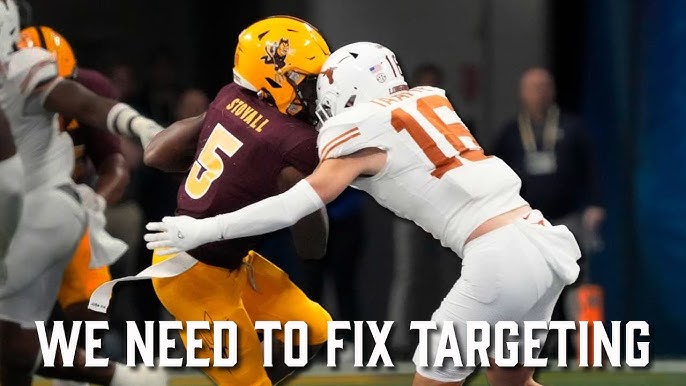
As the 2025–26 college football season concludes, no rule remains more polarizing than Targeting. Designed as a vital safeguard against head injuries, the rule has become a lightning rod for criticism due to its “strict liability” enforcement and the game-altering severity of its automatic ejections.
However, as of January 2026, the tide appears to be turning. NCAA officials, led by National Coordinator of Officials Steve Shaw, have confirmed that the rule is under intense review this offseason to become “less punitive” while maintaining its safety standards.
The State of the Rule in 2026
The current targeting rule (enforced via Rules 9-1-3 and 9-1-4) requires three elements to be “confirmed” by booth review for an ejection to stand:
- A Defenseless Player: A receiver in the act of catching, a sliding QB, or a kicker.
- Forcible Contact: Hits to the head or neck area, or hits delivered with the crown of the helmet.
- An Indicator of Targeting: A “launch,” a “crouch-and-thrust,” or leading with the helmet/shoulder.
The “Second Half” Problem: One of the most hated aspects of the current rule is the carryover penalty. If a player is flagged in the second half, they must sit out the first half of the next game. This recently affected Miami safety Xavier Lucas, who missed the first half of the 2026 National Championship due to a hit in the Fiesta Bowl.
The “Flagrant” Proposal: Tiering the Penalty
The most significant change on the table for the 2026 season is a move toward a tiered system, similar to Flagrant 1 and 2 fouls in the NBA.
- Targeting 1 (Common): For hits that meet the technical definition of targeting but lack malicious intent or “extreme” force. Penalty: 15 yards; No Ejection.
- Targeting 2 (Flagrant): For hits involving a clear “launch,” predatory intent, or excessive force to the head of a defenseless player. Penalty: 15 yards; Immediate Ejection.
Steve Shaw, NCAA Secretary-Rules Editor: “What targeting has driven in terms of player behavior change has been really good… But how can we continue this trend of taking out more of these hits we don’t want while being less punitive?”
⚖️ The Great Debate: Pros vs. Cons
| Arguments for the Tiered System | Arguments Against Softening the Rule |
| Fairness: Eliminates ejections for “accidental” head-to-head contact caused by a runner dipping late. | Safety: Critics fear that removing the threat of ejection will lead to a “15 yards is worth it” mentality for big hitters. |
| Consistency: Reduces the impact of “subjective” calls that vary between officiating crews. | Legal Liability: The rule was partially born to protect the NCAA from concussion-related lawsuits; softening it could open new doors. |
| Player Development: Allows young players to learn from mistakes without losing precious game time. | Slippery Slope: Coaches worry that “Targeting 1” will become a “catch-all” that increases the total number of flags thrown. |
The “Science” Behind the Flags
Despite the fan outcry, the NCAA points to data as its shield. Recent studies (including a three-year study by the now-dissolved Pac-12) found that the rate of concussion on plays where targeting was confirmed was 49 times greater than on standard plays. Officials argue that the threat of ejection is the only thing that has successfully “re-trained” defenders to keep their heads up and “see what they hit.”
What’s Next?
The NCAA Rules Committee is set to meet in February 2026 to vote on the “Flagrant” proposal. If passed, the new tiered system would be implemented for the 2026–27 season, potentially ending the era of the “unjust” automatic ejection.


Author Profile

- CEO NGSC Sports
Latest entries
 NewsSeptember 12, 2026A Nation Rebound: How Sports Rebuilt the Collective Spirit After 9/11
 NFLSeptember 11, 202649ers Dominate Rams 27–7 in Historic Australian Opener
 NBASeptember 11, 2026The Daktronics Angle: How a Scoreboard Deal Triggered the SEC
 NFLSeptember 10, 2026Lock Steps In, Defense Closes: Seahawks Edge Patriots 13–10 in Opener
About the Author