Photo Credit: BC.edu
 0
0
 0
0
College football often gets defined by rivalries, rankings, money and championships. However, there is another side to the sport that deserves attention. Football can bring thousands of people together for reasons far bigger than winning. Some traditions honor heroes and military service. Others support children facing serious illnesses. Still others remind fans that football can create meaningful connections beyond the stadium. The Iowa Hawkeyes have one of the clearest examples of this softer side.
The Hawkeye Wave
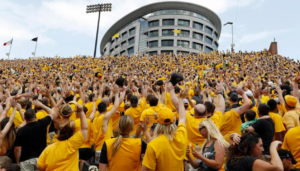
The Hawkeye Wave began during Iowa’s 2017 season. Kinnick Stadium sits next to the University of Iowa Stead Family Children’s Hospital. The hospital’s upper floors provide patients with a view of the football stadium. After the first quarter, everyone inside Kinnick turns toward the hospital. Fans, players, coaches and visiting players wave toward the children. The patients and their families often wave back from the hospital windows. More than 70,000 people can participate during Iowa home games. The tradition started after Iowa fan Krista Young suggested the idea online. The suggestion quickly spread across social media before the 2017 season opener. It has since become one of college football’s most recognizable traditions. Iowa also created the Kid Captain program in 2009.
The program honors a child during every home game. Each Kid Captain receives a commemorative jersey and special team recognition. Since 2022, the Kid Captain also chooses the song for the Wave. That detail makes the tradition even more personal. The players aren’t simply waving at a hospital. They are recognizing individual children and their families.
Boston College’s Red Bandanna Game
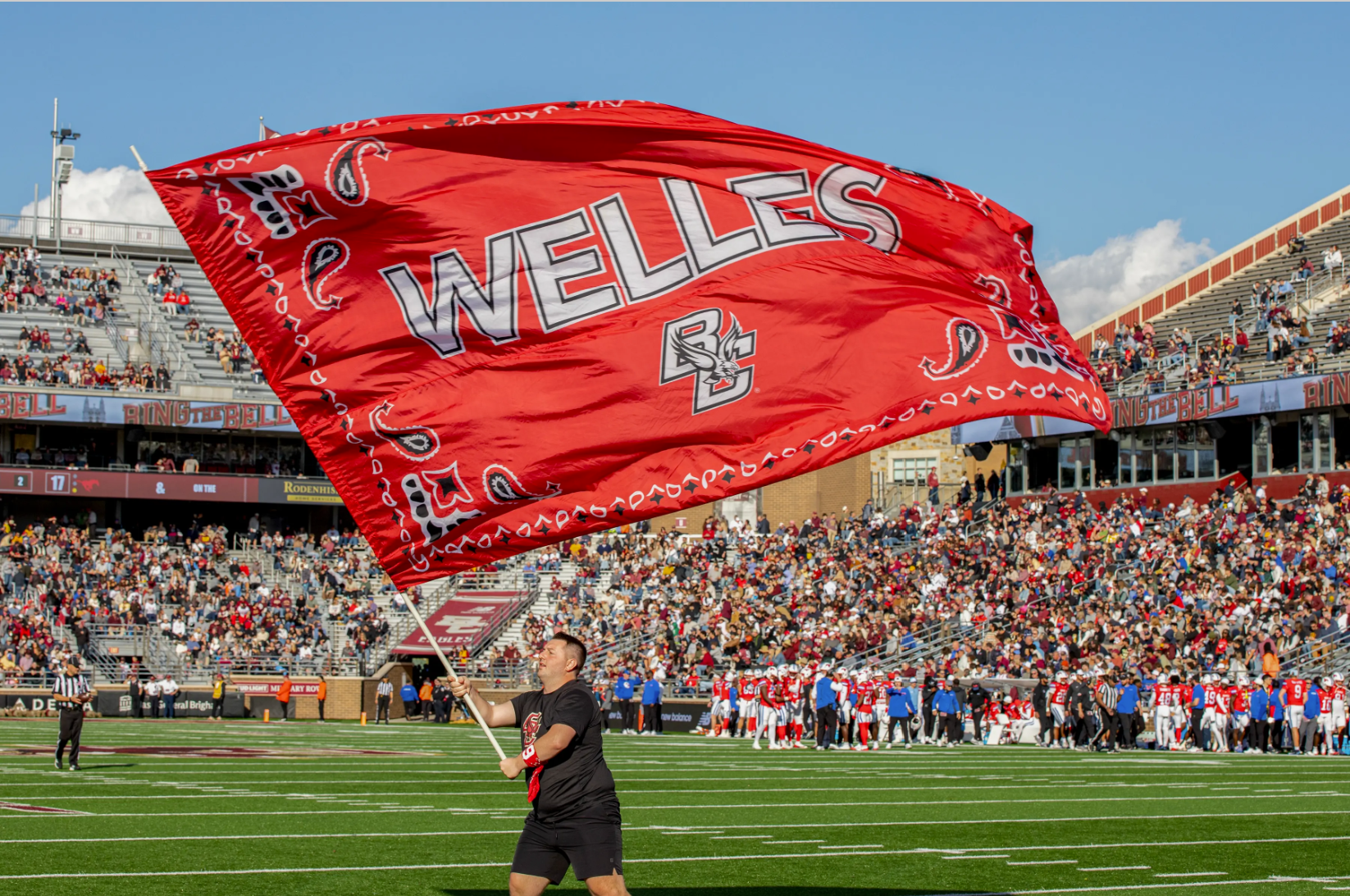
Boston College offers another powerful example. The Eagles created the Red Bandanna Game to honor Welles Crowther. Crowther graduated from Boston College in 1999 and played lacrosse for the Eagles. He worked as an equity’s trader at Sandler O’Neill in the World Trade Center. On September 11, 2001, Crowther helped people escape the South Tower. He wore his trademark red bandanna while guiding survivors toward safety. Crowther returned to the upper floors to help additional people. He ultimately lost his life when the South Tower collapsed. Boston College introduced the football tradition in 2014. The first Red Bandanna Game honored Crowther during a matchup against USC. The Eagles wore red bandanna designs on their helmets, gloves and cleats.
The university also distributed thousands of red bandannas to fans. The tradition now stands as an annual reminder of Crowther’s sacrifice. The 2026 game carried additional meaning. Boston College played Rutgers on September 11, 2026. The game marked the 25th anniversary of the September 11 attacks. Boston College called it the school’s 13th Red Bandanna Game. The Eagles defeated Rutgers 28-21 in front of more than 40,000 fans. The final score, however, wasn’t the most important part of the evening. The game allowed a new generation to learn Crowther’s story.
Nebraska and Team Jack
Nebraska football also has a meaningful connection with childhood cancer awareness. The story centers around Jack Hoffman. Hoffman received a brain cancer diagnosis when he was five years old. His family and community created the Team Jack movement in 2011. That movement eventually developed a strong connection with Nebraska football. Jack met Nebraska running back Rex Burkhead in 2011. That relationship eventually connected Jack with the entire Nebraska football team. Jack later became famous for his touchdown run during Nebraska’s 2013 spring game. The 69-yard run brought national attention to his story.
The Team Jack Foundation now raises money for childhood brain cancer research. In 2026, the foundation’s annual gala raised more than $800,000. The event drew nearly 700 guests and continued Jack’s legacy. Nebraska football also worked with Uplifting Athletes through its Team Jack connection. The relationship demonstrates how players can use their platform beyond Saturdays.
Penn State’s THON Connection
Penn State offers another example through THON. THON began in 1973 as a student-led dance marathon. Today, it supports Four Diamonds and families affected by pediatric cancer. The event culminates with a 46-hour dance marathon. Thousands of students participate throughout the year. In 2026, THON raised $18,841,726.53 for Four Diamonds. Those funds support children and families through Penn State Health’s pediatric cancer programs. THON isn’t a football tradition itself. However, it represents something important about the college sports community. Football programs exist inside larger university communities.
Those communities often rally around causes much bigger than athletics. Players Visiting Children’s Hospitals Sometimes the softer side doesn’t involve a stadium tradition. It simply involves players showing up. Texas football has regularly sent players to Dell Children’s Medical Center. Players have spent time coloring, played games and talked with patients. Those visits can give children a welcome break from hospital routines. Vanderbilt football has also developed a relationship with pediatric patients. Players have participated in hospital visits and pep rallies for children. Those moments give players another opportunity to connect with their community.
Tulane football players have participated in similar hospital visits. During the Armed Forces Bowl events in 2020, Tulane players visited Cook Children’s. They played games and interacted with hospitalized children. Southern Miss players also participated in the hospital visit. These moments rarely make the same headlines as touchdowns. Yet they can mean much more to someone sitting in a hospital room.
Army-Navy Represents Something Bigger
The Army-Navy Game provides another powerful example. The rivalry dates back to 1890. Both schools represent military service academies. Therefore, the players understand that their football careers connect with something larger. The game has long represented service, sacrifice and leadership. The National Football Foundation recognized those qualities when it honored the rivalry in 2025. The first Army-Navy game after September 11 carried particular emotional weight. The 2001 matchup took place just months after the attacks. Players on both teams understood that military service could soon become their reality. The rivalry continued, but the meaning surrounding it changed.
Football Can Mean More
College football will always revolve around competition. Fans will still argue about rankings and rivalries. Coaches will still obsess over game plans. Players will still chase championships. Yet these traditions remind us that football can represent something more. The Hawkeye Wave gives hospitalized children a moment of connection. The Red Bandanna Game keeps Welles Crowther’s story alive. Team Jack shows how one child’s story can inspire an entire football community. THON demonstrates how students can rally around families fighting childhood cancer. Hospital visits remind players that their influence extends beyond the field. The Army-Navy Game connects competition with service and sacrifice. That is the softer side of college football. Sometimes the biggest impact from a Saturday afternoon has nothing to do with the final score. Sometimes, it comes from simply remembering someone, helping someone or making someone smile.
This is the softer side of college football but this what makes the game so great.



Author Profile

-
Bradley Walker (VP) and Head of our Florida operations for NGSC Sports, bringing extensive experience across collegiate, professional, and amateur athletics. His coverage spans USF Athletics, including football, baseball, lacrosse, and softball, as well as University of Tampa baseball.
Bradley also provides coverage of minor league baseball with the Clearwater Threshers and Major League Baseball with the Tampa Bay Rays. On the national stage, he covers college football bowl games and conference championship matchups, along with premier golf events across the PGA Tour, LIV Golf, and LPGA Tour.
In addition to his reporting work, Bradley is the play-by-play announcer for Pinellas Park High School Patriots football, lending his voice and insight to Friday night lights.
He is also an active podcast host and contributor, serving as a host on The Walker Report, where he delivers in-depth sports analysis, interviews, and coverage across multiple levels of competition.
Latest entries
 AAC FootballOctober 10, 2026USF Falls to UTSA in Late Heartbreaker
 FootballOctober 10, 2026Bucs Stun Cowboys, Snap Losing Skid
 BaseballOctober 10, 2026Yankees Sweep: Who Deserves the Blame?
 FootballOctober 9, 2026New Coaches, Rough Starts
About the Author