 0
0
 0
0
Golf improvement has traditionally depended on access to courses, driving ranges and practice facilities. For many players, that means fitting practice around work, weather, daylight and travel time. Home golf technology is beginning to change that equation.
A modern golf simulator can give players the opportunity to practise more frequently, analyse their shots and play virtual courses without travelling to a golf club or driving range. As the technology becomes more accurate and more practical for residential spaces, home setups are becoming a serious training option rather than simply an entertainment feature.
For golfers looking to develop a more consistent game, having immediate access to a practice environment can make a significant difference.
Consistency Matters More Than Occasional Long Sessions
One of the biggest challenges amateur golfers face is maintaining a regular practice schedule.
A player might visit the driving range once every two weeks and hit 100 balls, but that does not necessarily create the same progress as several shorter, more focused sessions throughout the week.
Home golf makes frequent practice easier.
Instead of needing to travel to a range, golfers can work on their swing for 20 or 30 minutes whenever they have time. That could mean practising after work, hitting a few wedges before dinner or completing a structured session at the weekend without losing several hours to travelling and waiting.
This increased frequency can help golfers develop greater familiarity with their swing.
Golf is a game built around repetition. The more often a player can practise good movements and evaluate the results, the easier it becomes to develop confidence and consistency.
Turning Every Shot Into Useful Information
Another important development in home golf is the amount of information now available after every shot.
Traditional practice often relies heavily on observation. Golfers watch the flight of the ball and try to judge whether a particular swing produced a better result.
That can be useful, but it does not always explain what actually happened.
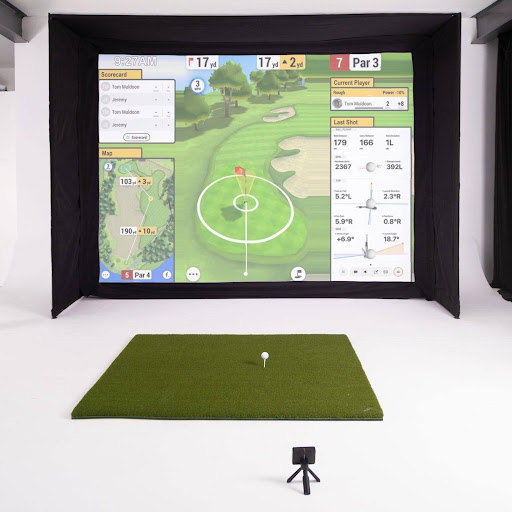
Modern launch monitors can provide detailed measurements relating to ball flight and, depending on the model, club delivery. Players can study information such as ball speed, carry distance, launch angle, spin and shot direction.
This creates a very different type of practice environment.
A golfer experimenting with driver setup, for example, can compare the results of several swings rather than relying purely on feel. Someone working on wedge distances can measure exactly how far different swing lengths carry the ball.
The numbers are particularly valuable when they are used to answer specific questions.
Is a new swing thought improving consistency? Is a driver adjustment creating more carry? Are wedge distances becoming more predictable?
When players have reliable feedback, practice becomes less about guessing and more about understanding.
Home Practice Can Be More Focused
It is easy to arrive at a driving range without a clear plan.
A golfer buys a bucket of balls, starts with a few short irons and eventually progresses to hitting driver repeatedly. The session may feel productive simply because plenty of balls were hit.
That does not always lead to meaningful improvement.
A home setup can encourage more structured training because golfers are not trying to finish a bucket of balls or make the most of a limited range visit.
A player could spend an entire session hitting only 60-yard wedge shots. Another session might involve trying to land ten consecutive 7-irons within a defined target area.
Driver practice can focus on dispersion instead of maximum distance.
That level of specificity can make practice considerably more useful.
Golfers can identify a weakness, build a session around it and compare the results over time. The aim becomes improving performance rather than simply accumulating swings.
Creating the Right Space at Home
A home golf setup does not have to resemble a commercial simulator studio.
Many golfers use garages, spare rooms, garden buildings or other suitable indoor spaces. The most important consideration is ensuring there is enough room to swing safely and naturally.
Ceiling height should be checked carefully, particularly for taller players and anyone using longer clubs. Width is also important because golfers need enough space around them to complete a full swing without feeling restricted.
Depth requirements can vary depending on the equipment being used.
Some tracking systems are designed to operate close to the hitting area, while others require more distance between the golfer, ball and screen.
For that reason, measuring the available space should always come before choosing equipment.
A typical setup may include a hitting mat, tracking technology, an impact screen or net and a display. More complete installations may also include a projector, enclosure and dedicated computer.
However, functionality should come before appearance.
The best home practice area is one that feels comfortable enough to use regularly.
Better Distance Control Through Repetition
One area where indoor golf can be particularly useful is distance control.
Many amateur golfers know roughly how far their clubs travel, but their estimates are often based on their very best shots.
That can lead to poor club selection on the course.
Repeated indoor practice allows golfers to develop a more realistic understanding of their average carry distances.
A player may discover, for example, that an 8-iron consistently carries 138 yards rather than the 150 yards they previously assumed. That information can immediately improve decision-making during a round.
Wedge practice becomes even more valuable.
Golfers can create specific swings for 40, 50, 60 and 70 yards and monitor the results over dozens of shots. Over time, those distances can become much easier to reproduce.
For many players, improved distance control will save more shots than trying to add a few extra yards to the driver.
Indoor Golf Can Keep Practice Going All Year
Golfers in regions with cold winters or wet seasons often face long periods when regular outdoor practice becomes difficult.
Even when courses remain open, limited daylight can make weekday golf almost impossible for anyone working traditional hours.
Indoor practice removes much of that seasonal disruption.
Players can continue working on their swing throughout winter and arrive at the start of the main golfing season having maintained their timing and feel.
This can be particularly helpful for golfers who usually spend the first few weeks of spring trying to rediscover their game.
Instead of beginning again after several months away from regular practice, they can continue developing throughout the year.
Virtual Courses Make Practice More Engaging
Home golf is not limited to technical training.
Simulation software allows golfers to play virtual courses, compete with friends and create challenges around different aspects of the game.
That element of entertainment can actually support improvement.
Practice becomes easier to maintain when it remains enjoyable.
A golfer may begin with 30 minutes of technical work before playing a virtual nine holes. Another evening might involve a closest-to-the-pin competition or a round with family members.
Simulated course play can also create situations that require more decision-making than traditional range practice.
Instead of hitting the same club repeatedly, players need to change clubs, adjust targets and think about how they want to approach each shot.
It is not identical to playing outdoors, but it introduces variety and helps prevent practice from becoming repetitive.
Useful Technology for Golfers of Different Abilities
Home golf technology is sometimes associated with highly technical players who want to analyse every detail of their swing.
In reality, different golfers can use the same equipment in very different ways.
Beginners may simply want to see where the ball is going and practise making more consistent contact.
Mid-handicap players might focus on dispersion, club distances and reducing a common miss.
More experienced golfers may pay closer attention to spin, launch conditions and smaller changes in ball flight.
The value comes from choosing the information that is relevant to the player’s goals.
There is little benefit in becoming overwhelmed by dozens of numbers. Good practice usually starts with a specific objective and uses only the data required to measure progress.
Building a Setup Around the Way You Practise
Before creating a home golf area, golfers should consider what they actually want from it.
Someone mainly interested in swing improvement may prioritise tracking accuracy and a quality hitting surface. A golfer who expects to play virtual rounds regularly may place greater importance on screen size, projection quality and simulation software.
Families may want a space that can be used for both serious practice and entertainment.
Thinking about these priorities early helps create a better-balanced setup.
It also reduces the risk of spending heavily on features that may rarely be used.
The most effective home golf environment is not necessarily the most expensive. It is the one that makes regular, purposeful practice easier.
A More Accessible Approach to Improvement
Home golf technology is changing the relationship golfers have with practice.
Instead of improvement depending entirely on driving-range visits and favourable weather, players can now create a training environment that is available whenever they have time.
The real advantage is not simply the technology itself. It is the opportunity to practise more frequently, measure progress and approach each session with a clearer purpose.
Outdoor golf will always provide challenges that cannot be fully recreated indoors, from changing lies and weather to course management and putting on real greens.
But home practice can complement those experiences extremely well.
For golfers who want to understand their game better and make improvement part of their regular routine, a thoughtfully designed home setup can become one of the most useful training tools they have.



Author Profile

Latest entries
 FitnessSeptember 30, 2026How Protein Supports Different Types of Fitness Goals
 The HubSeptember 30, 2026How to Add Halloween Patches to Your Costume the Right Way
 GamingSeptember 29, 2026Transparent Rewards and Next-Generation Digital Casino Bonuses in 2026
 GamingSeptember 29, 2026Megaways Slots Challenge Traditional Fixed-Payline Engines Across Online Casino Lobbies
About the Author