Photo Credit: Reddit
 1
1
 0
0
Building a Super Bowl champion remains one of the NFL’s greatest challenges. Every general manager approach roster construction differently. Some prioritize elite quarterbacks, while others invest heavily in defense or the offensive line. However, recent history proves there is no universal blueprint. Instead, successful teams combine strong drafting, smart free-agent signings, and timely trades to create championship-caliber rosters. The 2025 season highlighted just how unpredictable the league can be. The Seattle Seahawks captured the Super Bowl with Sam Darnold at quarterback. Many doubted that path before the season began. Nevertheless, Seattle paired Darnold with one of football’s best defenses. Although Darnold played well during key stretches, especially in the NFC Championship Game against the Rams, he admitted he struggled during the Super Bowl. Fortunately for Seattle, its defense, led by Devon Witherspoon, consistently carried the team when needed.
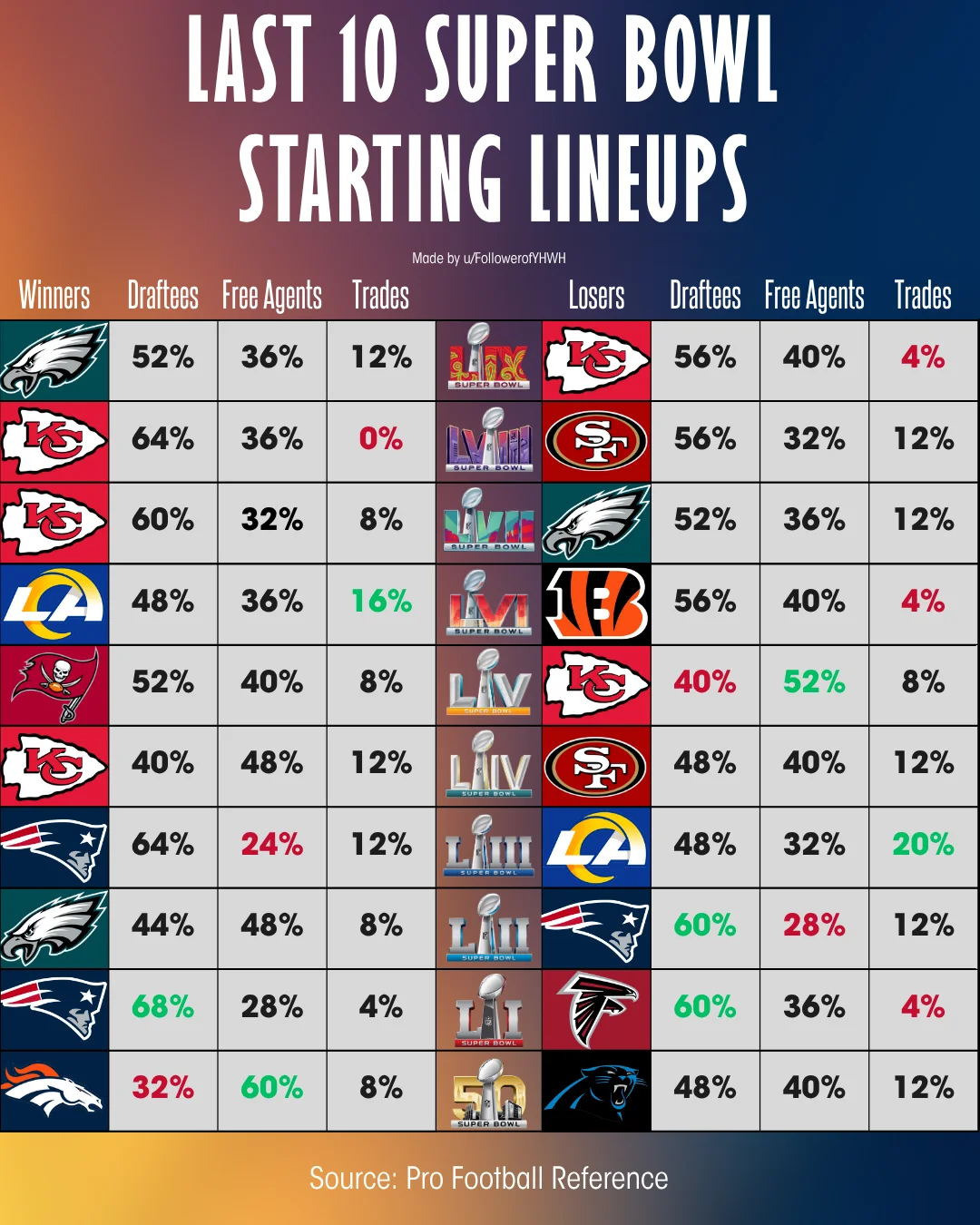
Meanwhile, the New England Patriots reached the Super Bowl through a completely different strategy. One year after ranking among the NFL’s worst teams, New England transformed its roster with an aggressive free-agent spending spree. At the same time, the Patriots benefited from a major leap by their second-year quarterback. Similar improvements previously helped quarterbacks like Patrick Mahomes, Lamar Jackson, and Carson Wentz lead their teams deep into the playoffs. The study examined 30 Super Bowl teams from the 2011 season through 2025. Researchers analyzed 20 key starters on each roster, including offensive and defensive playmakers. The goal centered on identifying how contenders acquired their most important players. Although every championship team looked different, several consistent trends emerged.
Quarterback remains the most important position. Of the 30 quarterbacks studied, teams drafted 24. Those 24 included 12 top 10 selections, one mid-first-round pick, five Day 2 selections, and six Day 3 picks. Teams acquired only two quarterbacks through trades. Four arrived through free agency. Those numbers reinforce the value of drafting and developing quarterbacks. However, they also show elite talent can emerge outside the first round. Tom Brady accounted for five Super Bowl appearances as a Day 3 selection. Brock Purdy added another. Russell Wilson, Jalen Hurts, and Colin Kaepernick also proved teams can find franchise quarterbacks after Round 1.
Running back produced far more variety. Teams drafted 18 of the 30 featured backs. Eight joined through free agency, while four arrived in trades. Only one lead running back entered the league as an undrafted free agent. Furthermore, successful teams found productive runners throughout the draft. Several championship clubs relied on Day 2 or Day 3 selections instead of premium first-round picks. Wide receiver revealed another interesting trend. Teams usually invested heavily in one elite receiver. Then they filled the second spot with a less expensive option. Twenty lead receivers came through the draft, while six arrived via trades and four through free agency. Conversely, teams acquired 17 second receivers through free agency and only 12 through the draft. That balance allowed front offices to spend resources efficiently across the roster.
Tight end proved surprisingly stable. Teams drafted 23 of the 30 primary tight ends. Thirteen came from Day 2 selections, while nine arrived on Day 3. Only four joined through free agency. Great tight ends rarely reach the open market because teams usually extend them before free agency begins. Offensive tackle also favored homegrown talent. Teams drafted 19 starting left tackles and 20 starting right tackles. Left tackle remained one of the league’s premium positions. Therefore, organizations often invested first-round picks there. However, veteran additions like Andrew Whitworth and Trent Williams also demonstrated that experienced players can anchor championship offensive lines.
Interior offensive line positions showed greater flexibility. Teams drafted 39 guards and 19 centers. Nevertheless, organizations frequently found productive guards during Day 3 or through affordable free-agent contracts. Likewise, centers often emerged from Day 2, Day 3, or undrafted free-agent classes. Jason Kelce and Creed Humphrey perfectly illustrate that value. Defensively, edge rusher remained a premium investment. Teams drafted 18 primary edge rushers and acquired seven through free agency. Meanwhile, second edge rushers usually came through cheaper methods. Successful organizations often paired one star pass rusher with a lower-cost complementary player.
Defensive tackle required even greater draft investment. Teams drafted 24 lead defensive tackles. Remarkably, 21 of those players entered the league during the first two rounds. Only four lead defensive tackles joined through free agency. That trend highlights how difficult it remains to acquire elite interior defensive linemen outside the draft. At linebacker, teams leaned heavily on player development. Forty-two linebackers came through the draft. Only 10 arrived through free agency. Although some clubs found productive veterans on inexpensive contracts, most contenders developed linebackers internally.
The secondary offered the greatest flexibility. Teams drafted 29 cornerbacks and signed 19 through free agency. They also acquired 10 through trades. Safety showed similar balance. Teams drafted 32 safeties while adding 25 through free agency. Therefore, the defensive backfield remains one of the easiest areas to improve without relying exclusively on the draft. The study also highlighted broader roster-building lessons. First, drafting remains essential. Every Super Bowl team developed at least nine of its 20 key starters internally. On average, championship teams featured 12.2 homegrown starters, representing 61 percent of their core roster.
Additionally, middle-round draft picks often determine long-term success. The average Super Bowl team featured four first-round picks, four Day 2 selections, three Day 3 picks, and one undrafted free agent among its key starters. Those affordable contributors allowed teams to spend aggressively at premium positions without destroying salary-cap flexibility. The Los Angeles Rams continue to stand apart from most franchises. Their willingness to trade high draft picks for proven veterans remains unusual. However, even those Rams teams still relied on foundational players like Aaron Donald and Cooper Kupp, both drafted by the organization. Furthermore, by 2025, the Rams once again featured 13 homegrown starters among their 20 key contributors.
Another important finding centered on spending priorities. The average Super Bowl team had only three major investments among its 20 primary starters. In contrast, those same teams averaged 6.5 low-cost contributors. That combination allowed organizations to build complete rosters instead of relying solely on expensive stars. Ultimately, the study confirms there is no perfect formula for building a Super Bowl champion. Some teams win through dominant defenses. Others ride elite quarterbacks or aggressive free agency. However, nearly every contender shares one common trait. They draft well, develop talent patiently, and complement their stars with affordable contributors. When franchises consistently follow those principles, they give themselves the best chance to compete for championships year after year.



Author Profile

-
Bradley Walker (VP) and Head of our Florida operations for NGSC Sports, bringing extensive experience across collegiate, professional, and amateur athletics. His coverage spans USF Athletics, including football, baseball, lacrosse, and softball, as well as University of Tampa baseball.
Bradley also provides coverage of minor league baseball with the Clearwater Threshers and Major League Baseball with the Tampa Bay Rays. On the national stage, he covers college football bowl games and conference championship matchups, along with premier golf events across the PGA Tour, LIV Golf, and LPGA Tour.
In addition to his reporting work, Bradley is the play-by-play announcer for Pinellas Park High School Patriots football, lending his voice and insight to Friday night lights.
He is also an active podcast host and contributor, serving as a host on The Walker Report, where he delivers in-depth sports analysis, interviews, and coverage across multiple levels of competition.
Latest entries
 FootballSeptember 29, 2026554 Yards: The NFL Record Nobody Has Broken
 FootballSeptember 29, 2026Vikings Hold Off Buccaneers 23-16
 FootballSeptember 29, 2026Jaguars Dominate Patriots in Week 3
 GolfSeptember 29, 2026U.S. Rallies to Win 2026 Presidents Cup
About the Author