Getty Images
 0
0
 0
0
On October 30, 1974, in the sweltering, humid heart of Kinshasa, Zaire, 60,000 screaming fans gathered under the stars for a heavyweight championship fight that transcended sports. It was a cultural earthquake, a political spectacle, and ultimately, the setting for the most brilliant tactical gamble ever executed in a boxing ring: The Rumble in the Jungle.
At 32 years old, Muhammad Ali was attempting to reclaim the undisputed heavyweight title from a 25-year-old champion who didn’t just win fights—he destroyed people. What transpired over eight rounds redefined the limits of human endurance and ring psychology.
The Human Sledgehammer: The Terrifying Power of George Foreman
To understand the sheer audacity of Ali’s strategy, one must recall the absolute terror that was George Foreman in 1974.
Foreman entered the bout with an unblemished 40-0 record, featuring a staggering 37 knockouts. He wasn’t a technician; he was a walking natural disaster.
He had previously faced Joe Frazier—the man who had handed Ali his first career loss—and knocked him down six times in less than two rounds to take the belt.
He then faced Ken Norton—who had famously broken Ali’s jaw—and demolished him inside two rounds as well.
Foreman’s punching power was legendary. He hit with a heavy, thudding momentum that fractured bones and collapsed defensive guards. Entering the fight, bookmakers installed Foreman as a massive 4-to-1 or 5-to-1 favorite.
Whispers of Dread: Fearing for Ali’s Life
The mood leading up to the fight was not one of excitement; it was one of profound anxiety. Virtually no sports journalist or boxing insider believed Ali could win. In fact, many genuinely feared for his physical safety.
Prominent writers like Norman Mailer and George Plimpton noted a somber, almost funereal atmosphere in Ali’s training camp. The prevailing sentiment was that Ali was an aging superstar who was about to be brutally, permanently hurt by the heaviest puncher the sport had ever seen.
“George Foreman might be the heaviest puncher in the history of the heavyweight division,” wrote Dave Anderson of The New York Times before the fight. “Sooner or later, the champion will land one of his sledgehammer punches and, for the first time in his career, Muhammad Ali will be counted out.”
Even Ali’s closest confidants privately wondered if “The Greatest” had finally let his ego sign a death warrant.
Defying the Corner: The Birth of the “Rope-A-Dope”
The conventional game plan designed by Ali’s legendary trainer, Angelo Dundee, was simple and time-tested: Float like a butterfly, sting like a bee. Dundee wanted Ali to use his superior footwork to dance around the ring, stay away from the corners, and keep Foreman moving in the suffocating African heat.
But in the opening round, after throwing a series of shocking right-hand leads, Ali realized a harsh truth: the ring canvas was soft, the humidity was thick, and Foreman was a master at cutting off the ring. Dancing for 15 rounds would exhaust Ali long before it exhausted the champion.
So, in the second round, Ali did the unthinkable. He chose to lose his mobility.
Ali retreated to the ropes, leaned all his weight back into the slack elastic bands, and covered up. From the corner, a panicked Angelo Dundee was screaming at the top of his lungs for Ali to get off the ropes and dance. Ali completely ignored him. He was executing a secret plan he had brainstormed after watching a sparring session—a tactic publicist John Condon would later immortalize as the “Rope-A-Dope.”
Absorbing the Storm and Wearing Down the King
For the next six rounds, Ali turned the perimeter ropes into an energy-absorbing shock absorber.
Instead of taking the full kinetic force of Foreman’s sledgehammer body shots into his spine and legs, Ali leaned far backward out of the ring, letting the elasticity of the loose ropes absorb the brunt of the impact. He kept his gloves tightly pinned to his face, forcing Foreman to hit nothing but forearms, elbows, and air.
But the physical defense was only half the battle; the psychological warfare was the masterpiece. As Foreman swung with murderous intent, emptying his gas tank with every wild haymaker, Ali would lean into his ear during clinches and taunt him.
“They told me you could punch, George!”
“Is that all you got?”
“You disappointed me. You’re hitting like a kid.”
An enraged Foreman reacted exactly how Ali wanted him to: he threw harder, wilder, and faster, blinding himself with frustration while the tropical heat baked the oxygen right out of his lungs. By the fifth and sixth rounds, Foreman’s punches began to lose their snap. His arms felt like lead weights.
The Masterpiece Concluded: The Eighth-Round Knockout
By the eighth round, the trap was fully sprung. George Foreman was a spent force, stumbling forward out of pure instinct, his guard completely dropped due to exhaustion. Ali, who had conserved his energy by leaning on the ropes and pacing himself, knew the moment had arrived.
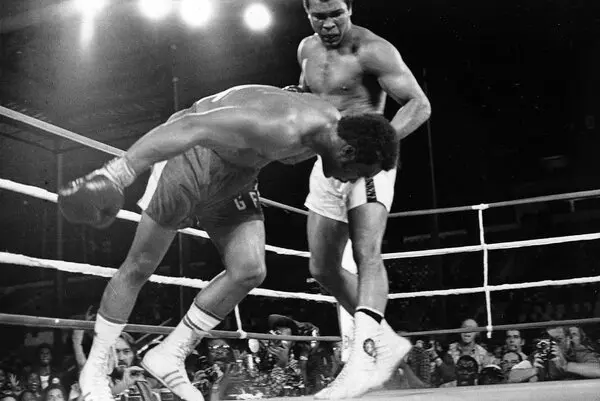
With 30 seconds left in the round, Ali exploded off the ropes. He unleashed a blinding, staccato combination: a left hook that spun Foreman around, followed by a perfectly timed, laser-accurate right cross that caught the champion flush on the jaw.
Foreman spun wildly, staggering across the ring like a falling skyscraper before crashing to the canvas. He tried to beat the count, but his body refused to cooperate. The referee counted him out.
Muhammad Ali had shocked the world, reclaimed his crown, and cemented his legacy—not just as the most charismatic fighter to ever live, but as one of the greatest tactical geniuses in modern sports history.


Author Profile

- CEO NGSC Sports
Latest entries
 NFLSeptember 3, 20262026 NFL Season Preview: Motivated Chiefs, Star-Studded Rams, and New Offenses
 NBASeptember 3, 2026Hammer Down: The NBA’s Historic Sanctions Cripple the Clippers’ Present and Future
 WNBASeptember 2, 2026WNBA Recaps: The 2026 Playoff Picture at the FIBA World Cup Break
 NFLSeptember 1, 2026Roster Trim Mayhem: Shocking Cuts, Quarterback Carousels, and What’s Next for NFL Rosters
About the Author