 0
0
 0
0
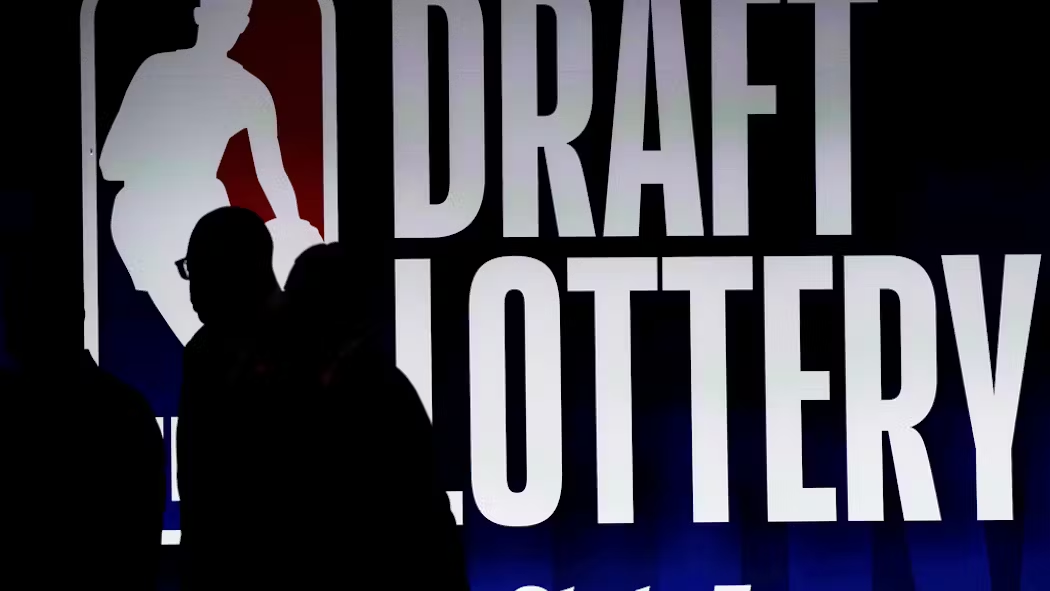
In what is being called the most aggressive move to protect the league’s integrity in decades, the NBA has officially unveiled a revolutionary draft reform proposal to its 30 general managers. Known as the “3-2-1 Lottery,” the plan aims to effectively end the “race to the bottom” by punishing the league’s worst performers while rewarding competitive mediocrity.
If approved by the Board of Governors on May 28, 2026, the new system will take effect starting with the 2027 NBA Draft.
The “3-2-1” Breakdown: How It Works
The proposal’s namesake comes from a new weighted system of lottery balls. The field will expand from 14 teams to 16 teams, and the traditional “worst record = best odds” logic is being thrown out the window.
The Reward Zone (3 Balls)
The teams with the 4th-worst through 10th-worst records will now have the best chance at the No. 1 overall pick.
- Each of these seven teams will receive three lottery balls, giving them each roughly an 8.1% chance at the top selection.
- This is designed to encourage teams to stay competitive late in the season to move out of the bottom three.
The Relegation Zone (2 Balls)
In a shocking twist, the bottom three teams in the league standings will be placed in a “Draft Relegation” area.
- These teams will only receive two lottery balls each, lowering their No. 1 pick odds to 5.4%.
- While they are “penalized” with lower odds, they are guaranteed a floor of the 12th pick, preventing a total freefall.
The Play-In Boost (1-2 Balls)
The lottery now officially includes teams that fought until the very end:
- Seeds 9 and 10 from each conference (the play-in participants) receive two balls each (5.4% odds).
- The losers of the 7-vs-8 play-in games receive one ball each (2.7% odds).
New “Anti-Dynasty” Restrictions
To prevent teams from camping out at the top of the draft for years (a strategy often referred to as “The Process”), the NBA is proposing strict frequency limits:
- No Back-to-Back #1s: A team cannot win the No. 1 overall pick in consecutive years.
- The “Three-Five” Rule: A team cannot have three consecutive picks in the top five.
- Protection Ban: Teams will no longer be allowed to include protections on traded picks that fall in the 12-to-15 range. This ensures that “middle-tier” picks actually move between teams as intended.
Expanded Disciplinary Authority
Commissioner Adam Silver has made it clear that “fixing tanking” is his top priority. Under this proposal, the league office would have the unilateral power to strip lottery balls or manually move a team down the draft board if an investigation proves they are intentionally resting healthy players to manipulate their seeding.
“The incentives need to be fixed,” Silver said following a recent Board of Governors meeting. “We are going to fix them. Full stop.”
Timeline & The Sunset Provision
- Vote Date: May 28, 2026.
- Effective Date: The 2027 NBA Draft (The 2026 Draft on May 10 will use the old format).
- Sunset Provision: The system is set to expire after the 2029 Draft, at which point the league will vote to either keep it or pivot to a new model.
This proposal signals the end of an era where losing was a viable business strategy. By the time the 2027 draft rolls around, the NBA hopes that “Tanking for the next superstar” will be a relic of the past.
Do you think the “Relegation Zone” is too harsh on legitimately bad teams, or is this the only way to stop teams from throwing games?


Author Profile

- CEO NGSC Sports
Latest entries
 LIVOctober 16, 2026The $100 Million Walk-Away: Inside Jon Rahm’s Shock Exit from LIV Golf
 MLBOctober 16, 2026Halpin’s Two-Run Blast and Bullpen Heroics Lift Guardians to 3–2 Game 3 Win Over Rays
 MLBOctober 16, 2026Clean Sweep: Brewers Erase 4–0 Deficit to Stun Dodgers 6–4 and Secure First World Series Berth in 44 Years
 MLBOctober 15, 2026One Win Away: Brewers Push Dodgers to Brink of Elimination with 6–2 Victory in Game 3
About the Author